 I have read enough lately about the health benefits of standing at my desk. But, my motivation really has been because of unrelenting pain due to an accident that fractured my knee and pulled tendons and ligaments and sub-luxated my hip. Sitting for long periods of time now is simply too painful.
Aside from having a hip replacement to solve the problem...they hope, I have pursued alternative solutions to aid my health in general. That got me to Rick Williams here in Santa Cruz who had been a great help. Through him I bought a Salli backless desk chair. It is really more like a saddle, giddy up! It has made a world of difference. Now I am researching a hydraulic desk that is sit/stand accommodating. I will keep you posted. Watching a client make this transition at Apple has been thought provoking. I am truly impressed how a company that values their talent is willing to do whatever it takes to accommodate an employee ergonomically. They are spending bunches more money on an adjustable desk than I am willing to do. But the investment is in improved health, productivity, lower medical expenses and time off, and high morale. I will keep you posted on the desk. Studies and articles listed on Jesse Noller's blog I found very helpful, thanks!
0 Comments
 The take-away of the article when building your career or making a career move is to get a reputation and visibility ahead of curve. The easiest way to do that quickly by leveraging the expertise, fame and reputation of other professionals.
It's simple really, set-up a blog and interview people working in your current field or new field. Pick the ones with the biggest networks. This creates overnight brand reputation for you as every one you interview will promote the interview blog posting to their network. If you are really ambitious, do a book. The article mentioned, " Remember, people judge how smart you are more on the basis of the questions you ask than on the answers you give". By asking very astute, thoughtful, and insightful questions,you look like an instant expert. Sure you are a thought leader in a month but continuing the interviewing as you expand your network is a long-term investment that maintains your brand in your field and keeps you on everybody's radar. ~~~~~~~~~~~~~~~~~~~~~~~~~~~~~~~~~~~~~~~~~~~~~~~~~~~~~~~~~~~ How to Become a Thought Leader in a Month or Less BY MICHAEL SCHEIN Thought leaders make more money, but getting there can be a real slog. Try this simple trick to become known as an expert in a fraction of the time. Here’s how the Oxford English Dictionary defines thought leader:“One whose views on a subject are taken to be authoritative and influential.” It’s no wonder so many business owners and executives invest millions of dollars trying to attain this status. Today, anyone can find countless alternatives to every product or service with a few mouse clicks. In this sort of environment, only those perceived as experts can truly thrive. Unfortunately, becoming a notable expert usually takes a long time, even in the digital age. Many people assume that if they throw up a blog and publish great content, members of their target market will find it. They won’t. There are literally millions of blogs and websites already in existence. The most successful thought leaders built their audiences by fostering relationships with other influencers they knew could effectively spread their message. Engaging in this kind of intense ongoing interaction can be grueling. Fortunately, there’s a way to shortcut the process. Target Your Own Circle FirstIf you’re a driven entrepreneur or executive, I’m willing to bet you have an extensive network of people with substantial knowledge and expertise. Like so much else in the business world, your personal network is the ideal place to begin when establishing yourself as a thought leader. Read full article here This is compelling data that shows a clear direction for people to take to pursue viable global employment. What the slide deck fails to address is that projected lack of employment opportunities regardless of how trained and prepared you are. At the World Economics Forum in Davos, 2012, the then CEO of Citi Bank declared that by 2020 the world would be 400,000,000 jobs short (read here).
The bigger issue address is not required skills and training but who will have access to opportunity and where?  I have been preaching from this hymnal for so long now. All my clients have not just robust social profiles but websites, iPad profiles, and blogs. Every profile and site is well curated and managed for image and reputation. Soon everyone will wake up to this and forget to angst over their resumes which nobody really sees in comparison.
Why would you worry about your employer seeing you? They are online touting themselves too. Linkedin is even encouraging high school students to join them now. ~~~~~~~~~~~ Your Web Presence Will Soon Be More Valuable Than Your Credit Rating by Philip Brewer on 5 February 2014 reprinted with links from www.wisebread.com When employers first started looking up their potential new hires on social media sites, recent grads started deleting whole Facebook accounts. That was better than having a fully documented history of bad behavior, but in the near future people are going to have to do a lot better. A blank social media history is going to be a bad social media history. (See also: 9 LinkedIn Changes You Should Make) The whole situation is directly analogous to credit ratings. Time was, a lot of people didn't even have a credit history — back when credit cards were a way to borrow money, rather than a mechanism for making payments. Plenty of people were proud that they'd never had to borrow money — figured it showed that they were responsible money managers. And often those same folks were terribly surprised when it turned out that having no credit history made it tough when they did want to borrow, such as to get a mortgage. The reason was simple: lenders wanted to see a demonstrated capability to make monthly payments on time, and people who had never borrowed money didn't have a history that showed that. (See also: How to Build Credit From Scratch) Very soon, having no online presence is going to be worrisome in just the same way. It's going to either mean that you're a complete nobody — or more likely, that your past behavior was so bad you couldn't clean things up by just deleting a few unwise posts. Building a Good Web FootprintThere used to be a lot of articles on how to build a good credit history. (The advice usually boiled down to: borrow a little money, make the payments on time, make the last payment a little early.) Now it's time for some similar articles on how to build a good web presence. We don't yet know what's going to be most important, but here are some ideas on how to get started. Be GradualYour web footprint should be built gradually, with posts spread out over time. Don't imagine that you can fake up a whole web history in a day, or even a few weeks. (For one thing, too many of the posts have hard-to-fake timestamps. But even aside from that, it's just hard to make up anything that has the richness of a real person's life, except by documenting it day-by-day.) Be NormalYour web footprint should make you look like an ordinary person, with various interests and a reasonable number of friends. A nice mix of posts — some quotidian updates liberally laced with quirky vacation stories, some links to interesting articles, photos with friends and with family, likes of local businesses — is going to look much better than two hundred posts all on the same topic (even if the topic is relevant to the job you're trying to get). Be ConnectedYour web footprint should make you look engaged. In addition to your own content, you should like and share other people's content — and you should have content that other people like and share. Don't look like you think you're above everyone else; don't look like nobody likes you. (See also: Why You Should Cultivate Relationships) Be HonorableYour web footprint should make you look unique and quirky — but like a good person. Don't have posts that make you look cruel or abusive. It's fine to have some stories about misadventures, but don't make yourself out to be stupid or incompetent. (Especially, don't make yourself out to be a criminal or a drunk.) Be DistributedYour web footprint shouldn't all be one place. Right now, probably the most important web presence to have is on Facebook, followed by Twitter, and then Google+. But there are dozens of other places where it's worth being engaged: Reddit, Pinterest, Tumblr, Flickr, Delicious, StumbleUpon, your own blog, etc. There's no telling what the next big thing will be. Fortunately, there's no need to be on the next big thing. Just make sure your whole web presence isn't all on one site — a lot of sites are going to disappear (or worse, become a joke for the people who have moved on to the next big thing). A Web Presence Is Cheaper Than an InterviewThe first time I was interviewed for a job, I was surprised at how little time was spent talking about my qualifications, and how much time was spent just talking. Only years later — after I started doing interviews myself — did I come to understand. By the time you get to the interview stage, the employer has already decided that you have the skills to do the work. In the interview, they're trying to figure out if you'll fit in. They want to make sure that you're not a jerk or a flake. But interviews are expensive — and however limited the picture of someone that you'll get from their web presence, it's often enough to spot the jerks and the flakes. (See also: 13 Ways to Make a Good Impression at Your Job Interview) If your web footprint makes you look like a jerk or a flake, interviews are going to be few and far between. But if your web footprint is so sparse that someone taking a good look at it comes away without any strong sense of the sort of person you are, there's every reason to fear that you won't get the benefit of the doubt. They'll just look at the next guy, and the guy after that. Soon enough they'll find someone with enough of a web presence that they feel like they've got a sense of the guy. That's the applicant they'll call in for an interview. Make sure your web footprint doesn't make you look like a jerk or a flake — and make sure it's dense enough that it looks real, and not like the creation of a few days of trying to fake something up (or a lifetime of bad behavior with all the bad posts hidden). Beyond the Job SearchYour web presence already matters in your job search, but soon it's going to matter for everything. Lots of interactions are already heavily reliant on social media reputation — dating (especially online dating, but also real-life dating), doing freelance work, selling second-hand goods, and so on. Credit scoring won't be far behind, and probably getting insurance as well. Time to get ready for it. Are you actively maintaining your online reputation? Has your online persona helped or hurt you? full article here  Canada's Start-Up Visa for foreign tech entrepreneurs, which opened for applications on April 1, is an important part of the Government of Canada’s plan to build a fast and flexible economic immigration system....
Initially, Citizenship and Immigration Canada (CIC) will collaborate with two umbrella groups: Canada’s Venture Capital & Private Equity Association (CVCA) and the National Angel Capital Organization (NACO). The immigrant entrepreneurs must secure a minimum investment of $200,000 if the investment comes from a designated Canadian venture capital fund or $75,000 if the investment comes from a designated Canadian angel investor group... For details, please check out http://www.cic.gc.ca/english/immigrate/business/start-up/index.asp Please feel free to pass it to a tech entrepreneur who may who can benefit from it. I am beyond unhappy with this Social Networking site based in Europe.
Unlike Linkedin, VIADEO used my uploaded address book to continuously and persistently spam my contacts with email invitations to join their site, several times a week. When I agreed to their invite to upload my gmail addressbook and invite my contacts to connect to me, I assumed that VIADEO would respect the privacy of my contacts. They did not. After VIADEO uploaded over 1500 contacts and started spamming them, I realized that I had to delete my contacts to stop the invitations from going to them. VIADEO gave me two options: delete the contacts one at a time, or delete my entire VIADEO account. I chose the faster route to delete the account with the 2000+ connections that I spent a number of years building. I am outraged by VIADEO's behavior and apologize to anyone reading this who has been subjected to their spam through me. I now realize why several people in my addressbook keep sending me the same VIADEO invitations several times a week. Their addressbook has been highjacked too. I will now let them know by email. I thank Linkedin for always respecting my address book and never spamming my contacts since I joined in 2003. I now hope that VIADEO won't continue to invite my address book in my name after my account is deleted. Surely, all those contacts are deleted too. If they aren't deleted, and VIADEO does continue to spam my clients, friends, and colleagues, I will seek a greater remedy than dissing their name over my network of 15,000+ connections on multiple social sites that this blog reaches. Amazing commentary on the politics of Silicon Valley and how even genius can lose.  On Google Search Page My Birthday Greeting and Cakes. I Especially Like the Jelly Roll! On Google Search Page My Birthday Greeting and Cakes. I Especially Like the Jelly Roll! And when I moused over the image it said "Happy Birthday Patti"! How cool is it to have a Google Doodle personalized for you? Is this brilliant marketing? Indeed it is as I am blogging about it.
But, there's more. They gave me a present, too! They offered me a personalized URL and of course I snapped it up: https://www.google.com/+PattiWilson Not to grouse over this, but it is about time because a personalized URL is the best way to help drive people to Google+. I haven't seen Google in a hurry to pass them out. In their typical style, they offer products selectively and roll out new services by word of mouth and invitation only. Compare this to the land rush Facebook conducted when it opened up their URLs on a first come first serve basis in one day. Why are these personalized URLs important to individuals beyond mere status symbols? Why have I made a point to get my name in every URL that I can and in every email service offered? Yes, I own pattiwilson in Yahoo, Outlook, and Google email. Well one's name is part of one's brand isn't it? It is how you are found in a Google search. People, hiring managers, headhunters, customers, networking contacts, blind dates will all search on your name in Google not your company. Think about it. You do it yourself when you want to find out about somebody. Moreover, Google's search algorithm gives preference to someone's name + a URL like pattiwilson.com or pattiwilson.net. It really doesn't matter what specific domain comes after it. It could be .me, .ca, .us, .whatever. The name attached to the domain is of key importance. If you have a common name, like mine, then owning multiple URLs in required to hold your place at the top of the first screen in a Google name search. If you share a name with someone famous who is in IMDB or Wikipedia, for example, then it is crucial to have multiple social sites and URLs with your name to compete against the big databases. It all adds up to greater visibility and a bigger digital footprint. What is the point of good branding if nobody can find you online? Thanks Google!  I don't often post promotions of this sort, but I like this company. I have read all three of their $5.99 eBooks on Management, Leadership, and Entrepreneurship. They are a bargain packed with great advice and information. Their website, Caliper Corporation has white papers, case studies and podcasts...all for free. And the event below is free! Caliper is in Princeton, NJ.
Why Women Leaders Are One of Your Greatest Talent Assets. I’d like to invite you to attend a complimentary networking and learning event we’ll be holding in Newport Beach, CA on November 7th from 8:00 a.m. to 11:00 a.m. at The Island Hotel Newport Beach on Why Women Leaders Are One of Your Greatest Talent Assets. This event will feature a panel discussion with three influential women leaders who will discuss their leadership journey as well as the challenges and successes they’ve dealt with in their careers. Also, Caliper expert Carol Chenot, VP of Organizational Development Services will facilitate further discussion by sharing the results of Caliper’s Women Leaders study, which will help you: · Ensure that gender diversity aligns with your corporate values · Build that diversity into your selection process · Understand the unique development issues that women leaders face and how can they be addressed · Learn how women in 2013 are addressing work-life balance proactively and productively. To reserve your spot and to view the agenda, click here. This will be a great opportunity for you to network with other Southern California leaders, hear the latest research, and explore practical tools for ensuring that gender diversity in your organization leads to targeted business results. Frank Costanzo Senior Vice President of Sales CALIPER Helping Companies Hire and Develop Top Performers Sloan Award Recipient for Excellence in Workplace Effectiveness and Flexibility 506 Carnegie Center, Suite 300 | Princeton, NJ 08540 | Office: (609) 524-1323  This Fortune article drills down into the world of APIs (application programming interface). An API is a building block of a program much like an amino acid is a building block of protein.
The article goes on to explain how APIs will integrate everything and to everybody. What does that mean to you? Travel, leisure, work, socializing made easier, more expedient and productive through technology. As my clients grasp the portent of this message, they stop arguing about whether or not they need to build an online brand and have a big digital footprint. They see the value of having a website of their own. And, they realize how crucial it is to stay up to date t Businesses must embrace the programmable world. Or die. October 22, 2013: 10:49 AM ET How APIs are disrupting every business. By Promod Haque FORTUNE -- The havoc the Internet has wrought on traditional business already dwarfs previous economic transformations, but we haven't seen anything yet. Companies of all sizes and across all industries are now facing a massive digital disruption that will permeate their cores. Information technology has been working its way into business processes for decades, but this is different: The apps, data and APIs that are driving this digital transformation are not just enabling business; they are becoming its very fabric. Whether digital native or analog immigrant, today's digital pioneers recognize that an app strategy is the key to customer engagement, user experience and business success. API management The programmable world depends on a powerful and flexible digital-ecosystem infrastructure that is invisible to the user. Implementing and managing all this hidden complexity is a massive undertaking, and most companies lack the necessary resources. One element critical to the programmable world -- API management -- is particularly complex. Fortunately, this complexity can be offloaded onto API platforms like Apigee (disclaimer: one of our portfolio companies), which is already enabling businesses such as Walgreens (WAG), Marks & Spencer and eBay (EBAY) to build powerful digital ecosystems that transform their business, without losing their focus on core competencies. For example, Walgreens uses APIs to leverage existing photo-printing services, letting customers print photos directly from their mobile phones to a local Walgreens store. The company has found that customers who engage with Walgreens in person, online and via mobile apps spend six times more than those who only visit stores. Similarly, AppDirect uses open APIs and IaaS with a new platform that connects developers to channel partners across different industries. This lets companies like Staples (SPLS) and Bell Canada (BCE) launch state-of-the-art app stores in just a matter of weeks. These app stores have ushered in a mobile post-PC era in which people increasingly expect a rich and personalized experience that seamlessly spans any app and device. Open-API platforms like Twilio help to enrich the mobile experience by letting developers add voice and messaging functionality to their applications. In the transportation industry, Twilio powers the Uber mobile communications platform that connects passengers to drivers of vehicles for hire. Customers tap a smartphone button, and the Uber cloud matches them to the nearest available member limo. Payment is made through the smartphone, so no cash is involved. In the hospitality industry, Twilio underlies Airbnb, which provides a trusted community for listing, finding, and booking unique accommodations around the world. The Airbnb cloud matches travelers with lodgings ranging from apartments for a night to villas for a month, and helps property owners to promote and monetize unused spaces. Participants can text each other through Airbnb anonymously, without revealing their phone numbers. Emerging digital ecosystems However, the really big opportunity is in helping traditionally analog industries -- such as healthcare, professional services, manufacturing and consumer packaged goods -- to emigrate to the programmable world. Finish reading the article here: The Internet of Things: dumb title for a technology tsunami changing every aspect of our lives10/23/2013 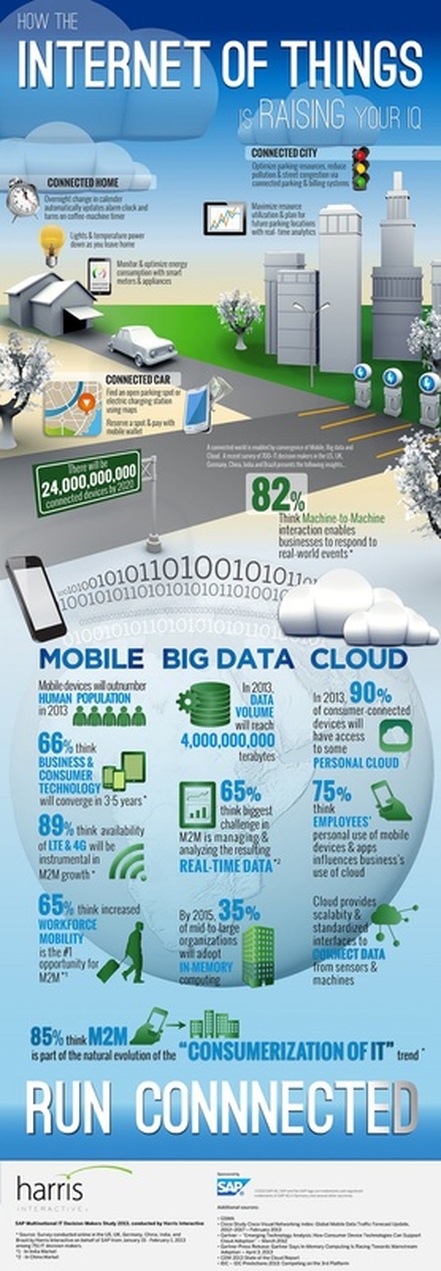 Well we just couldn't keep calling it mobility as in "mobile phone" when it is all pervasive, ubiquitous, and omnipresent in how we live, do business, and search for meaning.
I know a couple who never use the ATM, and do not own smart phones nor a computer. They have no clue about Facebook, GPS, Yelp, Amazon, and Google. Seriously. I used to call them Luddites, but now I call them Neanderthals. They are about to go extinct. There is a lot of content noise on the web arguing about the need or ROI of a college degree. While that debate can rage on, I know that there is no debate over the need to have our young people fully wired, connected, and technically savant. Regardless of training, diploma, or degree if they can't access and fluently use the Internet of Things, they will be unemployable. BUSINESS INSIDER INFOGRAPHIC: How The Internet Of Things Connects Everything And Everyone May 8, 2013, 3:20 PM In just seven years, there will be anywhere from 24 to 50 billion Internet-connected devices. That's three to 6.5 devices for every man, woman, and child on the planet. Those devices aren't just PCs, smartphones, and tablets, but also smart watches and eyewear, along with a lot of “things” we don’t usually think of as connected to the Internet: TVs, cars, appliances, shipping containers, and jet engines, to name a few. We're starting to live more connected lives through these “things.” Consider this example: A woman jogging through a park gets thirsty. She does a voice search on her smartphone for bottled water and is directed to a nearby vending machine, where she buys water using a mobile payment account on her phone. Sensing its supply is low, the machine alerts the distributor, whose automated supply chain management system adds that machine to the route of a passing delivery truck. Meanwhile, the jogger stops at a grocery store. Based on her recent activity, the beverage company sends a promotion to the jogger’s smartphone. She gets it just as she is deciding what drink to buy. Check out the infographic below for more ways in which the Internet of Things is changing our personal and corporate lives. And if your company wants to stay ahead of the curve, find out how to take advantage of the mobile technology that's connecting devices by unlocking exclusive content from the Harvard Business Review. Read more at the site:  It sure can and has been repeated. I have watched Whole Food gentrify an entire locale all buy themselves in less than 6 years. Now that is brand magic! Status by association, indeed.
Who are you networked with? Who are you name dropping in your CV and on your blog? How can you shine in the glow of an other's radiant sun? There is a lesson to be learned here aside from eating organic and free range. If we worked as hard on our brands and reputations as Whole Foods has then people would want to hang by with us too, and even hire us. Can the Whole Foods Effect Be Repeated? By Kriston Capps Urban-issues columnist Will Doig tackles the so-called Whole Foods Effect in a Salon story about development in Detroit—and well, development in every city that’s seen significant gentrification in the last decade or so. Detroit is the latest—following Washington, D.C., in 2000, Pittsburgh in 2002, and Boston last year—to see a neighborhood jolt following the announcement of the arrival of a Whole Foods. In Detroit, developers are betting big that the Whole Foods Effect will transform Midtown—$4.2 million big, Doig reports. “That figure suggests city leaders believe that Whole Foods is a force unto itself that can give a neighborhood the escape velocity it needs to break free of its doldrums,” he says, and then asks: “Are they right?” Doig writes that Whole Foods occupies a unique position in the food-market eco-system: It’s a debt-free company with 50 new stores coming online. Businesses piggyback off of Whole Foods’s advance work: The company looks for neighborhood areas with 200,000 people (a college-educated set at that) living within a 20-minute-drive radius. That may be Whole Foods’s greatest signal to developers and businesses: They’ve done the math so you don’t have to. The numbers bear out, Doig writes: An exhaustive 2007 study by Johnson Reid quantified the effects that individual urban amenities have on home prices. Using hedonic modeling, it found that a specialty grocer will increase surrounding home prices by an average of 17.5 percent, more than bookstores, bike shops or gyms (with the caveat, of course, that this varies greatly depending on the situation — in the instances studied, the increases ranged widely from 6 to 29 percent). Then he digs into the effect it’s had on D.C.’s Logan Circle neighborhood (which is a stone’s throw from ARCHITECT’s offices): When Whole Foods moved onto P Street in Washington, D.C., 13 years ago, the only nightlife on the block was a divey (and awesome) rock club called the Vegas Lounge. The Lounge is still there, but it’s since been joined by a popular burger joint called Stoney’s, a “food-to-fork” locavore restaurant called Logan Tavern that owns a farm 30 miles south of the city, a Starbucks (open till 8 p.m.), a coffeehouse-slash-bar called Commissary and several retail stores, all squeezed onto the same block as Whole Foods. His D.C. example raises a couple of salient points. One big plus to the P Street N.W. Whole Foods is its design: Its parking lot is small and underground, as it was clearly meant to fit into the neighborhood, not replace a big chunk of it. Many of the Whole Foods throughout the U.S. Northeast, in fact, are designed to encourage walkable communities. Other grocery stores in D.C. looked like the original Whole Foods in Austin, Texas—that is, a stand-alone, big-box grocer with a great deal of its footprint set aside for parking. When the D.C. Whole Foods opened it 2000, it was the only grocery store signaling urban density at the time. Back then, Whole Foods was also one of relatively few grocery stores serving D.C. at all. A Safeway store popularly known as the Soviet Safeway—so named for its frequent shortages—was then the closest grocery store, and that one was a neighborhood away. It’s hard to say whether the Whole Foods Effect is the function of a singular urban-organic-brand signaling, or if Whole Foods is just a savvy company identifying niches in the marketplace. Doig puts this question another way: “Could a Safeway gentrify a neighborhood like Midtown Detroit? Could a Wal-Mart?” Doig says no—but Safeway and Wal-Mart want this answer to be yes. Wal-Mart is opening six new stores in D.C., and the preliminary designs that the company has released for its first foray into the capital look nothing at all like their sprawling cousins in the suburbs. They look like Whole Foods. Chains such as Safeway and Giant are updating their brands to follow; a popular Giant a mile or two up the road from the Logan Circle Whole Foods is known widely as the Gentrification Giant—because it appears to have contributed to (or to have benefited from) the sort of growth that the Whole Foods Effect describes. One thing is clear: When it comes to big-store grocers spurring urban growth, Whole Foods has won the first-mover advantage. Here is the source of this article  This article was written at the beginning of the now overheated job market in the San Francisco Bay Area. Today, the competition to hire talent is verging on crazy.
We are back to pre-dot.com hiring levels of employment. And that is a good thing because this is not a bubble and the rank and file of Silicon Valley was decimated during the bust. Over 3000+ companies went bust and tens of thousands lost their jobs. between 2000 and 2002. The downside now is that the cost of already expensive housing is on another vertical trajectory. ________________________ Investors may Request Acqui-hire Protection: Some VCs think they're getting cut out of their fair share. By Michael Arrington, contributor Fortune Magazine article read here Acqui-hires, if you aren't aware, are the acquisitions of startups by large companies (usually Facebook, Google and Twitter) that are made primarily for the teams, not the products..............Investors see themselves as being taken advantage of, providing capital for founders to essentially buff up their resume to get their dream job. When a company is acquired, they say, the value of stock grants should be considered acquisition value and divided up among all stockholders. If a founder leaves stockholders behind to take a lucrative side deal, they're not acting ethically. They haven't been thrilled for years now, but something's starting to change. There have been Bin 38-like whispers of some investors acting to fight back on these deals. A lawyer I spoke with says there are a variety of causes of action in an acqui-hire deal, all centered around the notion that there's a lot of money going to some shareholders (founders/employees) but not to others (investors). Specifically, the longstanding notion of equal treatment of shareholders codified in California, Delaware and most other state corporations codes. If deals are specifically being architected to give key employees very large payouts and investors very little, there are probably fraud, breach of fiduciary duty and other causes of action available to shareholders. The cause of action is relatively straightforward – the deal as a whole would be considered fraudulent based on the fact that the team's value is based largely on the fact that it has become a cohesive whole on the shareholder's dime, and is worth far more as a group than the aggregate of the individuals. No investor in her right mind would bring such an action, of course, because of the reputational fallout from doing so. I have heard of a couple of threatened and settled lawsuits, though, that never became public. What's really pissing off investors are the stories that get back to them. Statements made by high level executives like "f%$# the investors, there's nothing they can do" sound fine in a closed door meeting with an entrepreneur. It sounds less defensible in a deposition that becomes public. I doubt we'll see much of that, though, given the reputational issues I brought up above, plus the fact that most investors honestly aren't angered by these deals. But what I do believe we'll start to see are clauses being added to investment contracts that are designed to change these deals. Specifically these clauses would force all deal consideration around a deal – including stock options and stock grants to employees – to be pooled and distributed pro rata among all shareholders. This would likely kill many of these acqui-hire deals, since the stock grant portion of the deal is a compensation expense to companies. That means the government is paying for a sizable chunk of these acquisitions. Any attempt to pool the consideration and distribute away from employees would not only suck for employees, it would no longer be a tax expense for companies. That would make these deals some 50% more expensive to the buyers. Obviously employees wouldn't be thrilled to lose most of that compensation to investors, either. Ultimately the market will decide if these clauses stick, but when there's a downturn (and there's always a downturn around the corner) onerous clauses often find their way into deals, and can eventually become "standard." We would never ask for a clause like this at CrunchFund, and would counsel our companies only to consider it as a last resort. Additionally we would often counsel companies we've invested to take these types of acqui-hire deals when offered, if it's in their best interest. But, in the meantime, it would probably be a good idea for the buyers out there – specifically Facebook, Google and Twitter – to consider toning down the anti-investor rhetoric in these meetings. They're injecting a lot of emotion into a difficult issue, and that doesn't help anyone in the long run. Michael Arrington (@arrington) is a partner with venture capital firm CrunchFund, and was the founder of TechCrunch. This post originally appeared on his blog. 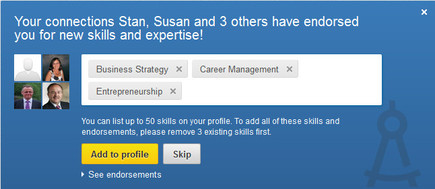 The article below was written when endorsements were launched last year.
After a year of testing the results are in on Linkedin.com endorsements and connections. The new rule of Linkedin is connections over the magic 500 with lots of endorsements that those connections will help generate. You need 50 skills listed with 50+ endorsements for each skill? Why? Well Linkedin has an algorithm that measures the value of each skill by the number of votes it accrues in relationship to your job title. This data is then aggregated and sold to recruiters. Voila! It is easier for them to find profiles that fit the jobs they are trying to fill. What goes by the wayside? Well remember long time ago (like 3 years) when Linkedin told you to connect to only people you trust? But now it gives you connection suggestions of profiles and people that may you know because they know that you need many more connections to get a reasonable number of endorsements per skill listed regardless of trust. Out of 100 connections maybe ten people will bother to endorse your skills when your profile is offered up to them. Another way to get more endorsements is to endorse everybody presented to you to endorse whether you have any knowledge of their abilities or not. People tend to reciprocate in kind. Some have even thanked me. Why LinkedIn’s Endorsements are Awful But You Should Use Them Anyway By David Wolinsky | Wednesday, Oct 3, 2012 | Updated 8:18 AM CDT Linkedin's new feature makes the profile from hell. Have you logged into your LinkedIn account lately? You should. It’s okay. Go ahead. We’ll wait. Back? Okay. The site has been getting a major makeover lately, and the latest wrinkle is the ability to endorse your colleagues and contacts. This is separate from the personalized recommendations. This lets anyone who is on your LinkedIn list who may or may not have ever worked directly with you acknowledge one of your skills. This is incredibly stupid for a variety of reasons. But I’ll start off with the first sign that shows this wasn’t fully thought through: When you endorse someone’s skill, an individual skill, it shows up in all your contacts’ feeds for each skill. You think Davis is really great at “magazines,” “marketing,” and being “friendly?” Well, everyone know now knows that you think that about Davis: Because they get an individual update about each individual skill. That’s just sloppy for a social media site. No offense, Davis, but I don’t really care that Evan -- who I haven’t spoken with since last September -- thinks you excel at “magazines.” I don’t even know what that means, but it’s a real skill people I know have listed. The other main point is what I already sort of touched on. Recommendations are great because they’re personalized. These are just random fist bumps from your Rolodex. So why should you use it? Because it’s LinkedIn’s attempt to “gamify” its site, and it lets you better assess someone’s skill set. If a master at “magazines” thinks you’re great at “magazines,” then that can only be a good thing, or at least better than Eli Whatshisname appreciating your skill. It’s a shaky first step towards further enhancing LinkedIn, but it needs a little more time in the oven. David Wolinsky is a freelance writer and a lifelong Chicagoan. In addition to currently serving as an interviewer-writer for Adult Swim, he's also a comedy-writing instructor for Second City. He was the Chicago city editor for The Onion A.V. Club where he provided in-depth daily coverage of this city's bustling arts/entertainment scene for half a decade. When not playing video games for work he's thinking of dashing out to Chicago Diner, Pizano's, or Yummy Yummy. His first career aspirations were to be a game-show host. See original article here  I can't disagree. He is absolutely right. All the people in Starbucks with laptops are entrepreneurial wanna bees not really in the game. People I have seen really make it in the Valley have eaten, slept, and lived their businesses at the expense of all else, including family. Then they run their companies expecting their employees to do the same. Just ask people former employees of Apple, Google, Oracle, etc.
___________ The latest shot in the work-life balance debate was fired by Mukund Mohan, a Bangaolore-based serial entrepreneur with roots in Silicon Valley, and author of the “Be a Force of Good” blog. Mohan’s most recent entry, “My discipline will beat your intellect,” argues that the key to start-up success is to recognize that it’s necessary both to “work smart” and to “work hard” – really, really hard. He writes, “Some ‘older’ entrepreneurs (usually over 35 years of age) will share their ability to ‘strike a balance’ between work and life. Practically speaking (I hate to break this to them) that does not exist in a startup. If you have that balance, you are not serious enough about your startup. read complete article here 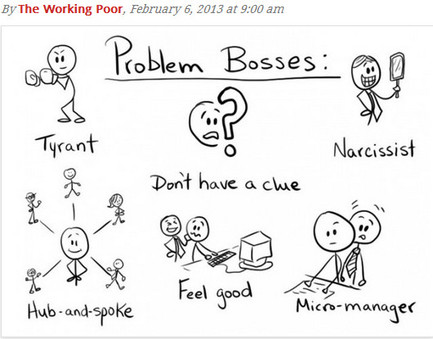 This comes as no surprise. I do a values assessment with clients to determine what has worked in previous jobs and what they want in future positions.
I have seen the majority of people leave for the lack of value satisfaction primarily caused by a bad boss, carnivorous teammates, or a toxic corporate culture. It was rarely if ever the money. Money factors in leaving if they have not gotten raises in several years or been passed over for promotions. Typically people focus on negotiating the money on the way in, so they know what they are getting. They often ignore the red flags on the people and culture. _________________________________________________________________________________ Hard to believe? According to Michelle McQuaid, a world leader in positive psychology interventions in the workplace, if you feel unappreciated, uninspired, lonely, and miserable, you’re not alone. In a survey of 1000 American Executives McQuaid found a “whopping” 35 percent of Americans are happy at their job. And, 65 percent say a better boss would make them happy. Only 35 percent say a pay raise will do the same thing.........A 2009 study published by the Harvard Business Review suggested, “…the majority of people say they trust a stranger more than they trust their boss.” read more here 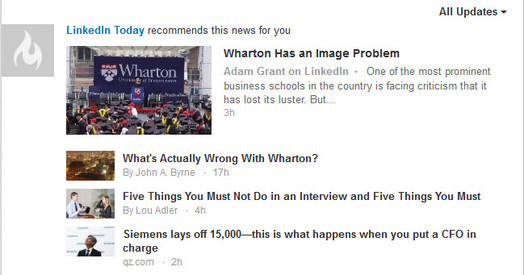 I woke up and logged into my phone to read the trending news on Flipboard :
Flipboard is your personal magazine, filled with the things you care about. Catch up on the news, discover amazing things from around the world, or stay connected to the people closest to you--all in one place. I next click on the news headlines from Yahoo News. Then I check out the weather.com box to see the beach weather and surf advisory. Finally I check the text messages from family. The information is all condensed, succinct and exactly what I want to read. Why? I pick the weather location, choose and curate by topic the magazines, and the news publications that I want to see. Well I don't pick my family. Then I go to Linkedin.com. I spend a lot of time there helping my clients build jaw-dropping profiles (just kidding, really, how much can you do with an inflexible template?). I actually help them quickly build out their networks to number in the thousands not the hundreds, decide on the best skills to list for endorsement, the most strategic groups to join, and the optimum wording for the over-structured profile template. While on Linkedin I go to my home page and there, chosen by Linkedin, are articles they have curated for me (they call it recommended). Why are they there? They did their algorithms on me and assume that's what I want to read based on my job and work experience. But, I don't want to read about my business. I know my business. I am an expert in my business. I want to read other news. I want to choose what I want to read! Search engines, social sites can do their algorithms and then use it to display ads to me and suggest topics they think I want to click on in the sidebar. But they cannot present me with totally curated pages of content they have decided I should read. I will leave as they aren't the only game in town. You can't do that on Linkedin.com they have a captive audience who have to follow their rules if they want to benefit from their service. Their rules have always been crystallized into precise, demanding structure that has worked for Linkedin from day one, but not necessarily for the user. They have been dogmatic and domineering about what kind of profile to fill out and how much information to provide. They demand dates, locations, chronology, and detailed structure. Why? Because then they can better slice, dice, and aggregate the information to sell it to recruiters and hiring entities who have been their main source of income. But now they are moving to a content model to become the one-stop business portal for all their members. True to form, they have decided what you will read and curated the content for you. Oh sure you can pick from their selected list of "influencers" but then that's all that they display to you. The image with this post is my Linkedin Home page today. None of it interests me. The updates that my 7000+ connections post are far more interesting and that's what I read. Just like you are reading this. And my updates to Linkedin come from, ironically, my curated boards on Flipboard or my blog posts. Will somebody tell Linkedin that their members would be stickier on their site if allowed to curate and share the content they choose and not what's chosen for them? And that people would work harder to build great profiles if they had more options, flexibility and control over them? 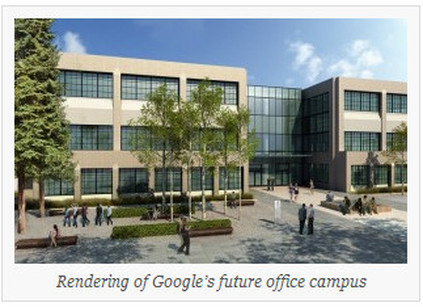 Originally the property was supposed to be 200+ badly needed housing units, but I supposed with the 24/7 work culture at Google, people can just sleep in their cubicles anyways. ~~~~~~~~~~~~~~~~~~~~~~~~ September 13, 2013 Google Leases Office Campus at Former Mall in Mountain View, Calif., from Rockwood, Four CornersBy Gail Kalinoski, Contributing Editor Google, Inc. is leasing 500,000 square feet – the largest lease signed so far this year in Silicon Valley – at the former Mayfield Mall in Mountain View, Calif., which is being repurposed by Rockwood Capital, L.L.C., and Four Corners Properties, L.L.C. into Class A office space. Once the site of the first enclosed, air-conditioned shopping mall in northern California, the 27.6-acre site at 100 Mayfield Ave. is adjacent to the San Antonio Caltrain station, it’s a 50-minute ride to downtown San Francisco. It operated as a mall from 1966 to 1986 when Hewlett-Packard bought it and used it as an office campus until it later closed that site. The property had been set to become a 260-unit housing complex. When those plans fell through, Rockwood and Four Corners bought the site for $90 million in late 2012. At that time, it was the largest sale of office space in Silicon Valley, according to Kidder Mathews. Neither the amount that Google is paying to lease the property, now being called San Antonio Station, nor the cost to renovate the buildings was released. A Google spokesperson would only confirm the lease and declined to discuss the tech giant’s plans for this site and whether it would affect other expansion in the region. Kevin Cunningham and Jack Troedson of Cornish & Carey Commercial Newmark Knight Frank represented the property owners. Steve Berkman, real estate partner at the Paul Hastings law firm, represented the landlord in the lease negotiation. “The renovation of the Mayfield Mall into a premier office campus will be a catalyst for the transformation of an evolving mixed-use urban location that benefits from rail,” Jason Oberman, vice president at Rockwood Capital, said in a joint release with Four Corners. “The repurposing of the former Mayfield Mall will incorporate the property’s historic architectural elements and will utilize green building techniques, modern design, and advanced building technology.” Read more If you don't start using Linkeding Skills, you are missing out on a tool to leverage your expertise. They are counting your endorsements.
 photo thanks to autoguide.com photo thanks to autoguide.com No the title is not my line. I am not that clever or cool. But I was impressed by the top executive search consultant based in Dallas who did use it.
And the point she was making? In searching for candidates for positions, she is able to recover much data and information that people leave in their wake online. Some of it is good and some of it is preferable to be gone. Your reputation is a piece of your brand, and anything found online that would tarnish it would be better removed or buried down multiple search pages in Google. Unflattering or uncomfortable Facebook photos are obvious culprits. But other items are more stealthy like political donations, real estate sales of multi-million dollar homes, complaints to the City Health Department by your neighbors, prayer meditations you led, lawsuits, participation in sports and events. You get the picture and so do the hiring managers. You have to decide how much you want to show to the world of your private life. If the answer is not much, then you must systematically and persistently work to push down the offending content. How is this done? The easiest way is to put brand-building content up that is fresher and newer, thus older material is pushed down. This will not work for listings in Wikipedia and IMDB but one assumes they have value for you. Posting content on sites like Quora, Vimeo and Tumblr would be helpful as well as profiles on the Linkedin competitors such as Viadeo, Xing, Apnacircle, Tianji and Orkut. They will give you a global reach as well. Of cours Google is top billing thanks to its algorithms to a named website and a named blog. What do I mean by named? Look at the URL name at the top of this blog. It is mine and therefore when Google sees it it gives it preference over other types of posted content. I did not mention how much work it is to put up good content and keep it there but it is a really small price to pay for being screened in for a job and not out.  Several advice columns in respected national news magazines have published articles from the career community on how to get hired into big name tech companies like Google, and Apple. I was literally stunned by some of the misguided advice I saw.
Much of it was from the last century just retooled with younger fresher language and jargon, but it was still the same: ask tough questions in the interview, take charge of the interview, present a work sample, send expanded thank you notes with business plans, prep your references, and be ready for the Mt Fuji impossible to answer questions. Let's try to set the record straight starting with the impossible questions like, “How do you move Mt Fuji?” They have been derided and discarded by the originators, Google and Microsoft, as not being effective measures of a good employee. They aren’t using them anymore. During the interview if you want to seal the deal, be the expert they expect and tell them what you know without any contrivances or grandstanding. But they already know what you know. They want to verify it and then see if you fit into their culture. Culture fit is why they test drive people as contractors. It would be redundant and low tech during an interview to offer a work sample when your samples, opinions, and track record should be easily found on your website/blog. They expect you to have large digital footprint. They will look at it before they even talk to you. They check your references in advance too through all your recommendations on Linkedin and other testimonials online. Since those are your references, it is best to have good ones. It behooves you to pave the way by getting to know people in the company who will vouch for you. These companies have very clubby cultures built on trust and comeraderie. If you have high level friends at them, then they will just walk you in, and you won't need to be a contractor. And, it is easier to be hired by one of their contracting agencies who will present your credentials and pave the way for you. Companies like Google, Facebook, or Apple all tend to hire larger ratios of (like 60%) contractors and compared to (40%) smaller numbers of perm employees. Start as a contractor and then do the temp to perm hire once they get to know and fall in love with you. The big sexy tech companies feel you should want to work for them. Then after paying your dues for a few years including being a contractor, then the rewards will flow towards you. So don't expect the red carpet when you are hired. They don’t all pay that well. Google and Apple are at the median or below on salary scales. Glassdoor.com will tell you that. Bigger salaries and more stock options for the same jobs are found in smaller companies who have to compete with the big guys for talent. If it is important to you to have a brand name tattooed on your CV then by all means go for the big name tech companies, but sometimes it is even better to be in on the ground floor with a startup, instead. All those name brands were start-ups once upon a time ago.  I have wondered by people don't use Linkedin requests more than they do. They don't know how to do it in a way that generates a response.
A Linkedin request was the original function of Linkedin to get people who were separated by degree to connect and exchange value with each other through intermediary introductions. However, most people have turned to the Groups function to find opportunities and people to open doors for them. And that works until you need to get to someone not in a group who is integral to an opportunity or business deal you want to consummate or explore. Then you must turn to the original way of reaching out to someone through the requests system. They are not easy to do successfully unless you are in sales and coming up with a pitch is your second nature. You have to give the intermediary a good reason why they dhould pass on the request even if you know them well. Why? Because the recipient of the request will be seeing what you write to the intermediary. The messages have to seam together with a congruent and compelling thread that incites the recipient to accept your request. It is not easy. People are busy and they don't want to be bothered. Read the suggestions for contacting him that the Linkedin founder Reid Hoffman writes in his profile: http://www.linkedin.com/in/reidhoffman. Advice for Contacting Reid: Unfortunately, I'm extremely busy. First: if you have an interest in getting my attention for an investment, working at Linkedin, a business development deal (for Linkedin or another portfolio company), then I *highly* recommend that you get an introduction to me. I am almost certainly not going to engage without a reference/introduction. Second: I am generally not available for new projects. If it’s a new project, you must have a great introduction. Otherwise, I generally recommend you indicate who you would like to be connected with at one of my organizations to proceed. Third: sadly, because I’m busy, if your communication to me is just a generic “ask” of me, I’m very likely just to decline it. Nevertheless, I wish you the best success if your project is a good improvement in the world. A generic "ask" is the kiss of death for any request especially if it self-interested. When making a Linkedin Request, especially job opportunity related, the more important the person is in the scheme of things the better the story you have to make to get a piece of their time. This is not about you and what the recipient of the request can do for you, but rather what you can do for them. There are two different messages to write and both will be read by the intended recipient of the request. Here is what to write:
This is essentially an abbreviated elevator pitch and your Linkedin summary should echo the messaging delivery and style as it is a full-blown elevator pitch about you. The better you get at this kind of deliver, the more improved will be your networking and interviewing results as well. Too often we rely on the kindness of contacts who make introductions that go nowhere when we follow up and tell an uncompelling story.  Adam's Linkedin Photo Adam's Linkedin Photo I met Adam over lunch years ago at the height of the dotcom boom. My first impression was that I was talking not just to a really smart (Cal Tech educated) guy but incredibly insightful too. He has a unique ability to extract the essence of a topic, distill it down to the essentials and easily create a system or set of rules to apply it or use it.
The same is true for his take on networking. I have advised clients for years to grow the biggest networks they can and forget about the "trust" slogan Linkedin uses. If you don't then when you need to extend your reach to access help then you end up paying Linkedin to reach out to strangers. The other two points he made about how to use a network: often and with those worth working with are the keys to making all your contacts and time spent count. Too often people don't network until they need something. They never think that possibly giving in advance might be a good thing to do for the purpose of reciprocation. But, giving to the right connections matters. As Adam says, we must keep our network cleaned up and weeded out of less supportive connections. ~~~~~~~~~~~~~~~~~~~~~~~~~~~~~~~~~~~~~~~~~~~~~~~~~~~~~~~~~~~ The Basics of Power Networking By Adam Rifkin www.linkedin.com/in/adamrifkin/ Two years ago Fortune magazine identified me as the best networker on LinkedIn; this in turn led to some wonderful stories in Adam Grant's excellent book, GIVE AND TAKE. Since then, every day people ask me about things I’ve learned about networking on Twitter, PandaWhale, and in real life. I feel fortunate to have learned networking from many excellent teachers, and the greatest of these teachers was actually the Internet itself. The top three lessons of Internet computer networking serve as valuable lessons for human networking, too:
1. Networks add value by getting biggerIt seems uncontroversial now, but that’s because our thinking has been so inflected by many years of access to a public, open, scalable Internet. Back in the day, many computer scientists argued that networks would maximize their value by being made out of nodes that were more tightly controlled by a single owner. Similarly, until recently, human networks were small, tightly connected, and controlled by gatekeepers such as elite colleges, social clubs, and prestigious professional organizations. The Web has been a great example of how technology — in the form of apps such as LinkedIn — can help foster more connections than can be maintained in real life. TIP: Since networks add value by getting bigger, use every day as an opportunity to grow the quality of your connections. I am often asked how I created my network, especially given that I am naturally introverted. It turns out that building a network is not hard; with time and patience, you can do it, too. The key is to tend to your network a little bit at a time, over the course of many years. A good rule of thumb is to connect with at least 1 and up to 3 people every day. More than 3 means you're not connecting deeply enough. Each interaction need not take long; you can get started with just a single five minute favor each day. It's not about time; it's about authenticity. The main way to deepen a connection is through genuine interactions that share knowledge and stories and emotions. 2. Networks add value by being used more There are many obvious downsides of heavy network usage: slowness, conflicts, lack of prioritization, lossiness, and low signal to noise ratio immediately come to mind. But the corresponding upsides include plenitude, ubiquity, rapid growth, and habituation. They don’t call them network effects for nothing! The same lessons apply to human networks: the more we reach out to our acquaintances, the more value we create not just for ourselves but for all of them, too. TIP: It is important to connect EVERY day. Let's repeat that: EVERY SINGLE DAY. Some connections can be new (and, ideally, with a warm introduction from a mutual connection). Some connections should be re-connections with "dormant ties" that deepen a connection already made. Relationships are progressions and re-connections are the fuel for that progress. Deepening 1-3 connections every single day makes you healthier, happier, and it's good for your career. 3. Networks add value by being fault tolerantIn many ways the Internet is the very worst designed network of all time (think about how often things fail when you're surfing The Web!) but paradoxically that is also its greatest strength. Every part of it was designed to fail early, often, and hard without impacting any other part too negatively. On the human level, I have learned that communities must also be designed to deal with messiness, loss, and failure. Unlike the architecture of the Internet, we also have the ability to learn and grow from the error conditions of life -- which ultimately makes the whole network stronger if we all share what we’ve learned.TIP: Tend to your network like a garden, a little every day, by weakening connections. Weed your garden: If someone demonstrates s/he is not worth growing a connection with, do not invest more time with that person. Instead, invest that time in someone who IS worth knowing better. Over time, your network will dynamically reflect your efforts, and be wonderful and helpful not just to you, but to your connections, too. We distill these lessons into 3 rules of thumb:
Interesting comparison between now and soon to be. Read the full article here
|