|
Scott Brinker's marketing technology blog is a wealth of information and data on all the tools related to marketing and sheds light on the newest C-level job creation, the Chief Marketing Technology Officer. Read the blog and find out more. Maybe your next career move would be in this direction. 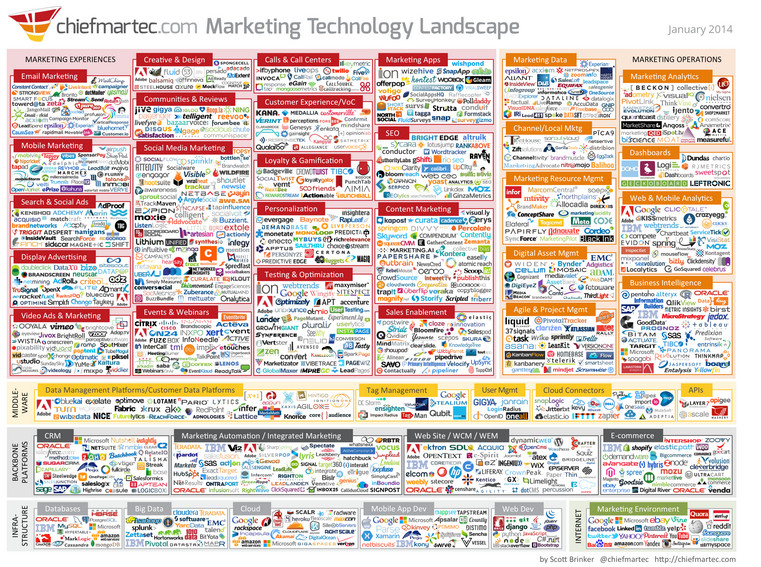
3 Comments
 New branding on a theory with a proven track record. Daniel Goleman wrote about EQ (Emotional IQ) several years ago making the point that people need not just smarts to get ahead as in IQ but the ability to relate to others as well. In fact the EQ was more important than the IQ all things being equal.
It is now as a theory moving into action and coming to real fruition with social networking and social media inside and outside organizations. Also globalization impels communications by video. The article is filled with good advice, and overview of the current situation. This continues to build a case for a good digital footprint that includes video, audio, image and content. Your first impression precedes you online and then in reality you will need to live up to it. ~~~~~~~~~~~~~~~~~~~~~~~ Why Likability Matters More at Work Likability Is More Important—and Harder to Pull Off March 25, 2014 7:03 p.m. ET, Wall Street Journal Is "Likability" is becoming a bigger factor for success at work as social networks and videoconferencing grow. The impact goes beyond a high-school popularity contest. The ability to come across as likable is shaping how people are sized up and treated by bosses and co-workers. Likable people are more apt to be hired, get help at work, get useful information from others and have mistakes forgiven. A study of 133 managers last year by researchers at the University of Massachusetts found that if an auditor is likable and gives a well-organized argument, managers tend to comply with his suggestions, even if they disagree and the auditor lacks supporting evidence. Likability is more important—and harder to pull off—on video than in person. Sometimes this can result in a style-over-substance effect. People watching a speaker on a videoconference are more influenced by how much they like the speaker than by the quality of the speaker's arguments, according to a 2008 study in Management Science. The opposite is true when a speaker appears in person. The use of personal videoconferencing is expected to grow 47% annually through 2017, according to Wainhouse Research, a Boston market-research firm. Read full article here  I don't often post promotions of this sort, but I like this company. I have read all three of their $5.99 eBooks on Management, Leadership, and Entrepreneurship. They are a bargain packed with great advice and information. Their website, Caliper Corporation has white papers, case studies and podcasts...all for free. And the event below is free! Caliper is in Princeton, NJ.
Why Women Leaders Are One of Your Greatest Talent Assets. I’d like to invite you to attend a complimentary networking and learning event we’ll be holding in Newport Beach, CA on November 7th from 8:00 a.m. to 11:00 a.m. at The Island Hotel Newport Beach on Why Women Leaders Are One of Your Greatest Talent Assets. This event will feature a panel discussion with three influential women leaders who will discuss their leadership journey as well as the challenges and successes they’ve dealt with in their careers. Also, Caliper expert Carol Chenot, VP of Organizational Development Services will facilitate further discussion by sharing the results of Caliper’s Women Leaders study, which will help you: · Ensure that gender diversity aligns with your corporate values · Build that diversity into your selection process · Understand the unique development issues that women leaders face and how can they be addressed · Learn how women in 2013 are addressing work-life balance proactively and productively. To reserve your spot and to view the agenda, click here. This will be a great opportunity for you to network with other Southern California leaders, hear the latest research, and explore practical tools for ensuring that gender diversity in your organization leads to targeted business results. Frank Costanzo Senior Vice President of Sales CALIPER Helping Companies Hire and Develop Top Performers Sloan Award Recipient for Excellence in Workplace Effectiveness and Flexibility 506 Carnegie Center, Suite 300 | Princeton, NJ 08540 | Office: (609) 524-1323 Interesting comparison between now and soon to be. Read the full article here
They have been doing the same ridiculous surveys for year and the results never change. Neither does the corporate response to the answers. Employees want to be better paid. It is no secret that the American worker's standard of living and income has continually lost ground over the past 30+ years. The workloads increases while the wealth has not trickled down and it is unlikely to do so as globalism continues to level the employment playing field. Only the very few types of skilled professionals will be sought after and well compensated. On the other hand, the continuous request for flexibility has shown some improvement over the years as global, distributed teams have increased the necessity to work remotely and at staggered times across borders, as has the increased cost of energy. It seems that having employees work from home saves on energy costs at work. People have wanted the same things since serfdom ended: to be recognized for work done not micromanaged for time put in, to be rewarded fairly, and to trusted and treated as thoughtful, contributing adults not mindless drones.  CareerBuilder Survey Reveals Most Wanted Office Perks and What Motivates Workers to Stay With Companies
CHICAGO, January 24, 2013 – .....A new CareerBuilder survey explores which job factors are most important to today’s workers. More than 3,900 full-time workers nationwide participated in the survey conducted online by Harris Interactive© from November 1 to November 30, 2012. Nearly one-third of employers (32 percent) reported that top performers left their organizations in 2012 and 39 percent are concerned that they’ll lose top talent in 2013. While most workers (66 percent) stated that they are generally satisfied with their jobs, one in four (25 percent) said they will change jobs in 2013 or 2014. How important is title? While upward mobility is a key factor in job satisfaction and employee retention, having a certain title isn’t important to more than half of workers (55 percent). The vast majority (88 percent) reported that salary matters more. Other factors that outrank job title in what is most important to workers are: · Flexible schedule – 59 percent · Being able to make a difference – 48 percent · Challenging work – 35 percent · Ability to work from home – 33 percent · Academic reimbursement – 18 percent · Having an office – 17 percent · Company car – 14 percent Read more  If you can’t get into a top-five MBA program, don’t even bother
By Jay Bhatti — January 15, 2013 Jay Bhatti is an investor and advisor to startups in New York City. Previously, he was the co-founder of the people search engine Spock.com. He also worked as a product manager for Microsoft. In 2002, he received his MBA from the Wharton School. Read more. The extent of his understanding about MBA is limited by his elitist world view. His main complaints are:
So, why get an MBA? For the network. Yes, the network. Example, UCLA is not in Jay's top five but it has over 30,000 alumni out there to help you with introductions, resources, access to opportunities, and career advice. That network doesn't become obsolete over time, better still, it keep on growing. You are buying a built in database of connections better than whatever Linkedin can do for you. Your fellow alumni are all invested in your success as much as their own as you will reflect back well upon them and the alma mater. How should you pick the MBA school? By the numbers. How many total graduates are there? How many in the geographical area of your preference. Example, most UCLA MBA alumni are in Southern California. How many are in the field or industry of your preference? Some schools are known for finance and accounting vs marketing and management. Do not pick an online school and degree as there is not enough connection and loyalty to the school to be good for networking. Pick a big enough school so that you have ample selection. Example, my degree from JFK University in Career Development was so small and niched that I practically know everybody in the alumni pool. Is an MBA worth it? If you want a career in business, yes, as a bachelor's degree is now the equivalent of a high school diploma for entry into the world of work.  A headhunter by definition is an employee or an external vendor who works to search, source, identify, and place the best possible available talent fit into a company's job opening.
Known as HR staffing, contingent recruiters, and employment agencies, they are paid by the companies who engage their services to hunt talent for them. Hence the nickname, headhunter. Everybody knows this, right? Why is it that headhunters are too often the first avenue used by professional and executive job seekers especially when unemployed? They are the least helpful resource when trying to make a big career transition. They are the most helpful when you are looking for the exact same job, industry, and position level in a different company. Most people are not. The reason why we have this knee jerk outreach to search firms is habit long ingrained into us. Our first experience with any kind of recruiter is when they appeared on campus to recruit new graduates and interns. They hosted pizza nights, gave away bling and cool toys at career fairs. They got some of us our first jobs. We make mistaken assumptions about them due mainly to a long, satisfactory history and pattern of relationship with them. Often, it was a headhunter who lured us out of a current position and into a new opportunity. In time, we used their help to fill our open openings. They continued to cultivate relationships with us as we grew in title and responsibilities. It is the the nature of their business. It only makes sense to let them know that we are looking when it is time for us to move on. But, don't assume that they may actively work in our behalf to help place us by way of reciprocity. Sometimes they will try to help but we cannot expect that they will act to our benefit. We tend to lose an objective perspective of the demands made upon them by their corporate and organizational clients. They are looking for the absolute best fit for a position in terms of industry background, professional experience and position level. Transferable skills are not a significant factor because they don't consider someone making a career transition the best possible fit for a position. Yes, the whims of the economy affect all hiring, as a headhunter may have the perfect position when we aren't looking or desiring to make a move. Timing is everything. Do make connections with headhunters, but don't expect what they simply may not be able to deliver...a job. 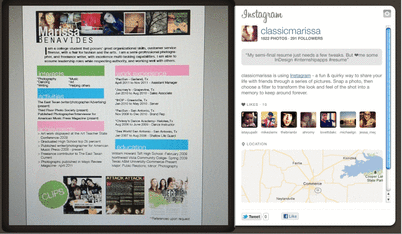 Business Insider has 23 examples of cool resumes using Instagram, the image-based website that Facebook just bought for $1 billion. They said in their intro:
It seems like a boring black and white resume won't get you very far anymore. Inspired by 7 cool resumes we found on Pinterest, we scoured Instagram for some more. Here are the most creative resumes we found. View all 23 here Some of the examples are stunning, others quirky, and all are young...very young. This really can work for you if you are under 30 and fighting for visibility in this very tough job market for early professionals. Certainly it can give anyone in the creative arts, digital media, and technology an extra edge and opportunity to showcase their talents. But will Instagram and Pinterest work for mid-career experienced professionals and senior executives? A qualified yes. It depends on the sector, the role and position level. In heavy equipment manufacturing at the C-level it would not be advisable. At least not this year. But in consumer packaged goods, fast moving consumer goods, hospitality, sports, recreation, entertainment, consumer electronics, fashion, advertizing, and technology sectors, those sites could well be a differentiating addition to your online branding. The position is important too. Traditional fields of finance, insurance, risk management, facilities management, for example, don't lend themselves, right now, to this kind of treatment. This kind of personal branding would not be expected nor accepted in more conservative sectors or professions. With all of the above caveats, in the parade, it is far better to ahead of the elephants and horses than behind. In 2003, when Linkedin launched nobody had ever heard of it let alone wanted to join and connect. Back then it was easy to get thousands of connections (and I did) and now you have to buy them. My advice is to register your name on Pinterest and Instagram to just hold a place for your profile. Eventually they will become acceptable social sites like linkedin is now and you then can leverage them for online branding. See all my blogs and website on Pinterest boards . Instagram is next.  http://arquazuarma.blogspot.com In an interesting addendum to the article below, I was speaking with a long-time client last night who told me that all the job postings up in Silicon Valley are not as accurate as one might think in the economic boomlet going on here. Apparently more hires are being done by headhunters outside the company and internal hires inside. The postings are window dressing to satisfy government requirements and to distract competitors. I can't tell you companies names but he got it verified by insiders at former places where he has worked. I double checked and agree. Why is all the internal hiring happening? Well it's faster, cheaper and, at least in Silicon Valley, the person has been "test driven". Typically anywhere from 20to 60% new hires are contractors. When an regular hire opening comes up, then the company sources internally from its contractor and consultant pool. That's my best guess on this. The other part of using headhunters for outside, well they control the deal flow so a fire hose of applicants isn't engulfing HR. With so much good talent out there looking, they can cherry pick top candidates with much less hassle than the company's staff can. Here is an excerpt from Peter Capelli's article. He is using his gut, anecdotal, hunching as well! HR leaders tend to try to push back against the fetish in their corporations to hire from outside instead of promoting from within. A new study offers some evidence to bolster their case. By My editors always say give away the story early on, so the answer is, "no." But it requires a little more background to make the story interesting. Probably the most important development in corporate life over the last generation or so has been the decline of lifetime careers and the rise of outside hiring. The situation in many businesses now is that, when there is a vacancy, they automatically think about filling vacancies by looking outside. Internal promotions are something of a rarity. I don't have any hard evidence for this, but my sense from anecdotes is that the outside hiring trend has been driven by CEOs and other top executives who (a) if they were hired from the outside think that is the way to go for other roles as well or (b) seem to have a "grass is greener" view of external candidates, especially those who come from an admired employer. read more here This is your new blog post. Click here and start typing, or drag in elements from the top bar.
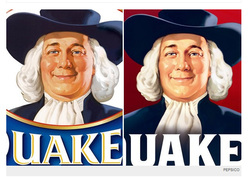 Younger, thinner, more interesting looking is the new oatmeal look. After 136 years, the Quaker Oats guy logo has been updated to appeal to a new generation of young adults as well as appeal to age-phobic baby boomers. If you compare the two logos, yes the one on the right is the new one, the new one shows an updated font style too that is a brighter white and not "old timey" looking.
According to the Time Magazine article, Quaker Oats owner PepsiCo introduced the changes in an effort to make the brand “fresh and innovative,” which might take a bit of doing, given that their product is a dessicated cereal grain. You may not be going on 136 years old, but when it comes to staying viable in the global talent marketplace, well then consider an update of your personal brand. How do you do that? Well it is less the wording in your content which focuses more on branding/rebranding. Rebranding positions you to move into new fields, business sectors, and industries. A brand refresh is gives your current brand a younger, more vibrant, newer, fresher appearance. That is more about image and look. At the warp speed of business and the Internet, a professional look evolves much more rapidly. Digital Documents in 2012 look different from those in 1998 Well, theoretically they should look different but some professionals are still using resume formats and layouts since before the faxed resume. Resumes, websites, blogs, or social profiles are built now to look great on a screen as that's where they are read. In fact, if you go to the Way Back Machine (Internet Archive) and check out early Linkedin, Amazon, blogs sites, you will see how different and dated they look now. The fonts now must take into consideration how well a font renders online and on a screen. Just look at the different in readability between the two Quaker Oats logos. Modern sans-serif fonts look younger and fresher. Serif fonts like Palatino render better onscreen than the traditional Times Roman, making for a crisper, fresher look. The layout and design of all documents are moving to a lighter, more open look. Just look at the new Google Blogger with dynamic, open blog that is image focused versus the blog you are reading now. The older you are, the younger your photo style Most executives use their photos provided by their company's PR department on Linkedin and for other business requirements. If you are over 50 and not working in government and financial services, this is not a good idea. More stable, traditional business sectors like seeing their executives in suits and business attire as does consulting services. There is a reason for the slang referring to "the suits". Using photos taken outdoors, in natural light, preferably in business casual will create an image of health, vitality and youth as well. Business formal creates age aura. If you have substantial career credentials and achievements, then you don't need to look the part as well. Take the photo one step further and be in dressy sports on a wind swept beach with a Golden Retriever. Lacking ocean, use a park and a poodle, or ski slopes, etc. Just don't look too much like you're into extreme sports. Remember how the category "interests" was put at the bottom of your resume and you got to list things like: biking, skiing, marathon running, etc etc? Well, one well done photos creates the better impression of you without the ubiquitous laundry list. Update your look, wardrobe, and appearance There is age discrimination and it is subtle, unconscious, and hard to prove when practiced in hiring and firing. In a media marketing driven, consumption based culture, we are manipulated by the image and look of products which are presented with an emphasis on sex, power, fun,and excitement. Yes, we like functional too, but we get sucked in by looks first. Think how many people wear those ergonomically uncomfortable, auditorially poor, and, basically, cheesy Apple iPod earbuds because they look cool and recognizable in white. A style makeover may not be annually necessary but every five years it is mandatory. This includes product: skin care, hair care, and body maintenance. There is a reason sites like Dermatologistrx is thriving online, and why both men and women no longer consider facial peels and lifts optional. It is not about looking younger which may be hard to archieve, especially after a certain age, but looking fresher, more vibrant and vital. The Quaker Oats guy looks thinner, healthier, and a bit younger and you should too!  These trends may seem not new to many in the career coaching field or in Silicon Valley but this article does an excellent job of covering and updating the take on these dynamics in global work:
5 Trends Driving the Future of Work by Chris Jablonski Summary: From legions of independent consultants to cities dotted with coworking facilities, the future of work is virtual, online and global. Trend 1: Independent consulting to see hockey-stick growth curve Trend 2: Order books, movies and now … workers online Trend 3: Coworking moves beyond early adopter stage Trend 4: Adaptive lifelong learning the norm Trend 5: Jobs of the future will either retrofit and blend existing jobs, or solve entirely new problems. Read more at ZDnet.com, Yes, we know that the jobs of the future will be different, even with the same title, from what they do now. Who would have thought that a car mechanic would need some computer skills to diagnose and repair the inner mechanics of an automobile 50 years ago? But they do now. Certainly, marketing exists more and more online than off. Challenge: predict where your job/field/function is going and how going are going to mutate into those changes yourself. One solution includes applying #4 and being continuously learning new skills before you need them. Coworking suits the Contract Nation USA just fine as more and more of the labor force is on a just-in-time basis. Banding together for company, economy of scale, and collaboration yet remaining independent entities is one very useful technique to survive working as Me Inc. Challenge: finding the right co-habitation work space with people who create synergies of opportunities and networks with yours. This is more critical than finding your soul mate. But the article does well in painting in tangible living color brushstrokes just how fast we are moving to that Me Inc. world with the visceral image of the hockey stick. Fan that I am, it also brings to mind the brutality of that game as an apt analogy to the sometimes cutthroat competition for projects and gigs. Challenge: to differentiate yourself and keep from becoming a commodity price-driven member of a herd of contractors chasing business. This is another place where #4 learning new skills and acquiring new knowledge would help. We know everything will be online as it seems like most of it is now. Of course recruiters live on Linkedin and deploy Google searches to find talent. Resumes are rapidly becoming obsolete in favor of more copious dossier on you in the interweb. Workers online using the various sites such as guru.com, elance, etc is now the norm. Challenge: to by-pass the 3rd party brokers that add on 20-30% to your hourly rate and market yourself directly to potential employers making copious use of online branding and marketing. Using a website, blog, social profiles (lots of them), etc, build visibility to promote Me Inc. Good trend spotting means good responses on all our parts. If we see it coming we can do something about it. Moreover, these trends are global. We compete, work with, network and collaborate across borders, timezones and countries. Opportunities can be anywhere and so can you. Email me if you want to find out how I can help you be a guru consultant and look like a thought leader online. I have done it for others and can show you how too. patti@careercompany.com Below is an extract from the Forbes article, " This One Leadership Quality Will Make or Break You". From the perspective of managing your career, this message resonates as well. Too often, we expect that all good things will come to us out of a expectation of deservedness.
These traditional axioms have embedded in them an expectation of deserving or being entitled: if we study hard, get good grades, work hard, meet our goals and objectives, dot the "i's" and cross the "t's" then great opportunities and career success will come to us. It is difficult to believe that there is an expectation of entitlement in those beliefs until for some reason they are not fulfilled. The shock of realization arrives when we find that exemplary performance is simply insufficient. Nowadays that can often be the case. In Lewis Carroll's children's story, "Through the Looking-Glass", when Alice was running with the White Knight through the woods, she asked him why they were running. His puzzling reply was that running was done to stay in the same place and to get anywhere they needed to run twice as fast. The essence of pursuit is to not expect that benefits will come to us if we do the right things. They don't anymore. There is too much competition for job openings, promotions, and opportunities. We need to be in active aggressive and continuous pursuit of our dreams and desires. We need to do it purposefully, with focused intent, and clear deliverables in mind. It is an interesting article: One of the most often overlooked aspects of leadership is the need for pursuit. Great leaders are never satisfied with traditional practice, static thinking, conventional wisdom, or common performance. In fact, the best leaders are simply uncomfortable with anything that embraces the status quo. Leadership is pursuit – pursuit of excellence, of elegance, of truth, of what’s next, of what if, of change, of value, of results, of relationships, of service, of knowledge, and of something bigger than themselves. Smart leaders understand it’s not just enough to pursue, but pursuit must be intentional, focused, consistent, aggressive, and unyielding. You must pursue the right things, for the right reasons, and at the right times. Perhaps most of all, the best forms of pursuit enlist others in the chase. Pursuit in its purest form is highly collaborative, very inclusive and easily transferable. Pursuit operates at greatest strength when it leverages velocity and scale. Read more at Forbes.com This may be just plain horse sense but I have been in the careers business for eons compared to freshly minted MBA graduates. Further having resided in Silicon Valley since before it had that name, I have seen many a CEO gain the title virtually overnight or, at least, with the launch of their start-up. Titles are inflated and virtually free here but making good on them becomes the challenge in high tech. However, the Forbes, "How to Become a Fortune 500 CEO" article addresses a much bigger pond for that title. Still the studies showed that a tech company CEOs had a much shorter timeframe to reach the top and were more likely to be recruited from outside the company. Other industries had much longer slogs to the top with the average executive arriving at about age 50 compared to a tech executive of 40 or less. It's not for every executive but for those that do succeed, the ROI is well worth the effort as well all know. Forbes article : read more here Passion is a funny, quirky emotion that comes and goes. But sometimes, in love and life, when you do passion right it has staying power. Scott wanted more than anything to ski everyday all winter long. He left before the last crash burst to follow his passion. An banking executive by trade, he made the big jump to a large, high-profile Canadian ski resort as a financial consultant in order to satisfy his passion for the slopes. He reasoned that going to a dead-end, boring job that would earn a small living as a worthwhile trade-off for a great skiing opportunity.
He is now the IT manager, supervising 2 reports, and managing a whole system upgrade with new software installations to manage ski-lift ticketing and lift operations. It turned out to be the best of all worlds as he loves his job, and is well-paid and pursues his passion. Why is it that some people land a job within record time while others seem to linger in a search limbo, languishing without really looking? Yes, there are obvious external factors that impact the length of an job search: age discrimination, requirements of an industry, heavily impacted functions and a few regions in deep recession. However, external factors do not account for everyone in search limbo. Seems that your degree of passion and engagement helps to determine the ease and ability to be out there and involved in that business and to be known and connected. They are just driven to do it and will continue to turn over rocks, go down paths and do whatever it takes to be in the game no matter how rusty or inept at networking they are. Passion can be the crucial ingredient to future success when one is in a transition phase between employment, consulting engagements or startup opportunities. Passion generates the motivation and drive to act and to do with the requisite intensity and persistence in the face of adversity, obstacles and daily doses of bad news reports. Certainly money is a key motivator, but people leave substantial incomes every day because they were simply miserable going into work every day. Organizations change over time, new management teams are formed that may not be compatible. Haven’t you seen people more consumed by their philanthropic work than their current position? That they pursue the former with more zeal than the latter can be a guidepost to other possible futures. They frequently come to realize that it is possible to make the avocation into the main career passion. Certainly, it is often too easy to be discouraged and dissuaded from making that kind of transition because passions seem to present themselves as financial and career risks. Sometimes it is not an obvious route to monetize a passion but we tend to foreclose options by pre-deciding against them. A woman had a passion for gourmet food, cooking, and great restaurants. Fortunately she lived in San Francisco so they all were in abundance. After years of working in public relations in consumer brands, she segued into the hospitality industry. She started with small steps: writing articles, attending food events to network and doing some public relations pro bono work for a small ethnic restaurant in to promote their unique cuisine. She is now with an executive in a San Francisco public relations firm in their food vertical. Yes, there are trade-offs to consider, priorities to rearrange and terms to come to but sorting out your values and options to put meaning, and passion back into their work lives will be worth the effort. People as Cogs: perception drives performance
by Nilofer Merchant | With peers in a few CEO roundtables, I've heard things like: "I plan on hiring 3 biz dev people to get $345K per headcount in revenues." After publishing a book about closing the execution gap by focusing on the "peopley" stuff, CEOs of major companies took me aside (in a friendly way) to suggest I had made a major faux pas, and would be seen as having gone "soft." In spite of a forest's worth of academic papers and rafts of best practices published by the likes of HBR on the importance of the "soft" stuff, most companies continue to treat people as inputs in a production line. I've had leaders ask me if this "people engagement thing" is something that can be added on, after the core business stuff is done, sort of like adding frosting to a cupcake. For the rest of this article visit ( http://blogs.hbr.org/cs/2011/06/people_are_not_cogs.html ) Harvard Business School Online This interesting short article pointed out the obvious persistence by the use of terminology in many executive suites and board rooms. However, even more engaging were the associated comments to the article. I believe the use of Web 2.0 has been the addition of comments to every article or news story. Further, that these comments can in turn be commented on by other readers creates a "just-in-time" community around that topic that embellishes, expands and enlivens the original far beyond the intention of the author. One detraction was the author's penchant to slang as in "gotta" when responding to comments. Two reader comments caught my attention. One placed the blame of the impersonal and objectifying language used such as "headcount" at the doorstep of business schools and their cirriculum. Given that most faculty had actual real world experience in the bowels of a company, I have to concur. One solution someone suggested was to put them on merit pay and remove tenure to see how quickly they start referring to themselves as "talent". But the other comment really was interesting and I take issue with it: I love the idea of the two camps being one - but the 'existence proof' you cite is, sadly, very flawed. Google and Apple are successful because they sell Market Leading - nay - World Leading products. The fact that they have different people-engagement approaches is, sadly, coincidental. By contrast, Henry Ford, also at a time when he was producing the World Leading Model T Ford, was treating his people like dogs. There is an enormous difference in perceived value between assembly line workers of Henry Ford's day and today's information/knowledge worker. Factory workers were treated as interchangeable parts and perhaps rightly so but, of course that doesn't justify the behavior. When someone leaves Apple or Google, part of the company's intellectual property just walked out the door. There is a reason that in tech companies in particular the term for Human Resources has been replaced by Talent Management. It seems fair to extrapolate that as work becomes more and more knowledge based, even manufacturing with AI, then regard for the talent that provides the intellectual horsepower will have to improve as well. And, yes, it will have to migrate to business school as well. I still keep thinking about the elegant and simple solution one of my clients had for the customer service backlog challenge they faced in a new position: Start from Where You Are.
Since he told me, I have found so many examples in my business and personal life where I have not done that and it has taken me years to get caught up and in some cases I have yet to do so. The epiphany I had today was with my client database. I have spent years trying to catch up on my client database starting at the beginning to bring it current so that I can keep in touch with them. That’s when the light bulb went on today. I need to just work on the database of current clients and then back-fill year by year going backwards to catch up with previous clients. Obviously, I have never caught up. In fact, I kept falling farther behind and I never will because of the nature of the escalating cycle. But I can be current now and go forward from here. Do you realize what a satisfying relief that is? There is nothing worse in business and careers to be in a self-fulfilling feeling of failure because of a mission impossible. How many companies continually set their employees up for the same demoralizing never-catch up cycle with every reorganization, merger and acquisition or new process? No wonder the change over to a different IT system, business process or cloud program is resisted. Whenever change happens people fall behind in their work unless it is handled properly. How many managers have the innate common sense that my client used? Start Where You Are Now. Certainly when making a career transition into a new industry or sector we struggle with starting with where we are now? We seem unwilling to leave our previous history behind. I seen professionals want to keep things on their resumes from 20, or even 30 years ago. They fail to realize that prospective employers Start with Where You are Now and they don't go back very far in your history to see how good a match you are with them. I heard a saying a long time ago that now in the context of this model makes perfect sense: Stop driving with the rear-view mirror. If you combined that with: Start Where You Are, then you have the ingredients of a dynamic forward moving life and career. http://www.kued.org/productions/utahnow/thejob
With an unemployment rate that has doubled over the past two years and a shifting economy, "The Job" begins to explore how all this has changed the expectations and realities of work. Produced by the Utah NOW team of Doug Fabrizio, Dave Castleton, Erik Nielsen, and Gary Turnier, this KUED documentary features the stories of people who left stable jobs to follow a dream. But there are also stories of those who couldn't make the dream work. "The Job" traces the history of work and the changing role of work in our lives and it chronicles the humiliating experience of losing a job and the daunting challenge of trying to find one. |