 I don't often post promotions of this sort, but I like this company. I have read all three of their $5.99 eBooks on Management, Leadership, and Entrepreneurship. They are a bargain packed with great advice and information. Their website, Caliper Corporation has white papers, case studies and podcasts...all for free. And the event below is free! Caliper is in Princeton, NJ.
Why Women Leaders Are One of Your Greatest Talent Assets. I’d like to invite you to attend a complimentary networking and learning event we’ll be holding in Newport Beach, CA on November 7th from 8:00 a.m. to 11:00 a.m. at The Island Hotel Newport Beach on Why Women Leaders Are One of Your Greatest Talent Assets. This event will feature a panel discussion with three influential women leaders who will discuss their leadership journey as well as the challenges and successes they’ve dealt with in their careers. Also, Caliper expert Carol Chenot, VP of Organizational Development Services will facilitate further discussion by sharing the results of Caliper’s Women Leaders study, which will help you: · Ensure that gender diversity aligns with your corporate values · Build that diversity into your selection process · Understand the unique development issues that women leaders face and how can they be addressed · Learn how women in 2013 are addressing work-life balance proactively and productively. To reserve your spot and to view the agenda, click here. This will be a great opportunity for you to network with other Southern California leaders, hear the latest research, and explore practical tools for ensuring that gender diversity in your organization leads to targeted business results. Frank Costanzo Senior Vice President of Sales CALIPER Helping Companies Hire and Develop Top Performers Sloan Award Recipient for Excellence in Workplace Effectiveness and Flexibility 506 Carnegie Center, Suite 300 | Princeton, NJ 08540 | Office: (609) 524-1323
1 Comment
 It sure can and has been repeated. I have watched Whole Food gentrify an entire locale all buy themselves in less than 6 years. Now that is brand magic! Status by association, indeed.
Who are you networked with? Who are you name dropping in your CV and on your blog? How can you shine in the glow of an other's radiant sun? There is a lesson to be learned here aside from eating organic and free range. If we worked as hard on our brands and reputations as Whole Foods has then people would want to hang by with us too, and even hire us. Can the Whole Foods Effect Be Repeated? By Kriston Capps Urban-issues columnist Will Doig tackles the so-called Whole Foods Effect in a Salon story about development in Detroit—and well, development in every city that’s seen significant gentrification in the last decade or so. Detroit is the latest—following Washington, D.C., in 2000, Pittsburgh in 2002, and Boston last year—to see a neighborhood jolt following the announcement of the arrival of a Whole Foods. In Detroit, developers are betting big that the Whole Foods Effect will transform Midtown—$4.2 million big, Doig reports. “That figure suggests city leaders believe that Whole Foods is a force unto itself that can give a neighborhood the escape velocity it needs to break free of its doldrums,” he says, and then asks: “Are they right?” Doig writes that Whole Foods occupies a unique position in the food-market eco-system: It’s a debt-free company with 50 new stores coming online. Businesses piggyback off of Whole Foods’s advance work: The company looks for neighborhood areas with 200,000 people (a college-educated set at that) living within a 20-minute-drive radius. That may be Whole Foods’s greatest signal to developers and businesses: They’ve done the math so you don’t have to. The numbers bear out, Doig writes: An exhaustive 2007 study by Johnson Reid quantified the effects that individual urban amenities have on home prices. Using hedonic modeling, it found that a specialty grocer will increase surrounding home prices by an average of 17.5 percent, more than bookstores, bike shops or gyms (with the caveat, of course, that this varies greatly depending on the situation — in the instances studied, the increases ranged widely from 6 to 29 percent). Then he digs into the effect it’s had on D.C.’s Logan Circle neighborhood (which is a stone’s throw from ARCHITECT’s offices): When Whole Foods moved onto P Street in Washington, D.C., 13 years ago, the only nightlife on the block was a divey (and awesome) rock club called the Vegas Lounge. The Lounge is still there, but it’s since been joined by a popular burger joint called Stoney’s, a “food-to-fork” locavore restaurant called Logan Tavern that owns a farm 30 miles south of the city, a Starbucks (open till 8 p.m.), a coffeehouse-slash-bar called Commissary and several retail stores, all squeezed onto the same block as Whole Foods. His D.C. example raises a couple of salient points. One big plus to the P Street N.W. Whole Foods is its design: Its parking lot is small and underground, as it was clearly meant to fit into the neighborhood, not replace a big chunk of it. Many of the Whole Foods throughout the U.S. Northeast, in fact, are designed to encourage walkable communities. Other grocery stores in D.C. looked like the original Whole Foods in Austin, Texas—that is, a stand-alone, big-box grocer with a great deal of its footprint set aside for parking. When the D.C. Whole Foods opened it 2000, it was the only grocery store signaling urban density at the time. Back then, Whole Foods was also one of relatively few grocery stores serving D.C. at all. A Safeway store popularly known as the Soviet Safeway—so named for its frequent shortages—was then the closest grocery store, and that one was a neighborhood away. It’s hard to say whether the Whole Foods Effect is the function of a singular urban-organic-brand signaling, or if Whole Foods is just a savvy company identifying niches in the marketplace. Doig puts this question another way: “Could a Safeway gentrify a neighborhood like Midtown Detroit? Could a Wal-Mart?” Doig says no—but Safeway and Wal-Mart want this answer to be yes. Wal-Mart is opening six new stores in D.C., and the preliminary designs that the company has released for its first foray into the capital look nothing at all like their sprawling cousins in the suburbs. They look like Whole Foods. Chains such as Safeway and Giant are updating their brands to follow; a popular Giant a mile or two up the road from the Logan Circle Whole Foods is known widely as the Gentrification Giant—because it appears to have contributed to (or to have benefited from) the sort of growth that the Whole Foods Effect describes. One thing is clear: When it comes to big-store grocers spurring urban growth, Whole Foods has won the first-mover advantage. Here is the source of this article 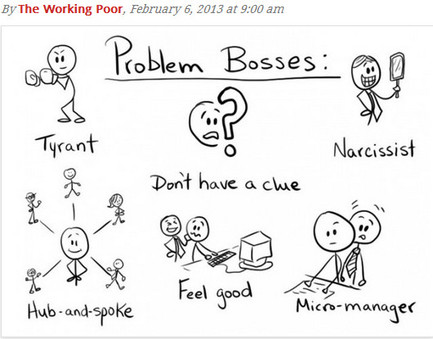 This comes as no surprise. I do a values assessment with clients to determine what has worked in previous jobs and what they want in future positions.
I have seen the majority of people leave for the lack of value satisfaction primarily caused by a bad boss, carnivorous teammates, or a toxic corporate culture. It was rarely if ever the money. Money factors in leaving if they have not gotten raises in several years or been passed over for promotions. Typically people focus on negotiating the money on the way in, so they know what they are getting. They often ignore the red flags on the people and culture. _________________________________________________________________________________ Hard to believe? According to Michelle McQuaid, a world leader in positive psychology interventions in the workplace, if you feel unappreciated, uninspired, lonely, and miserable, you’re not alone. In a survey of 1000 American Executives McQuaid found a “whopping” 35 percent of Americans are happy at their job. And, 65 percent say a better boss would make them happy. Only 35 percent say a pay raise will do the same thing.........A 2009 study published by the Harvard Business Review suggested, “…the majority of people say they trust a stranger more than they trust their boss.” read more here 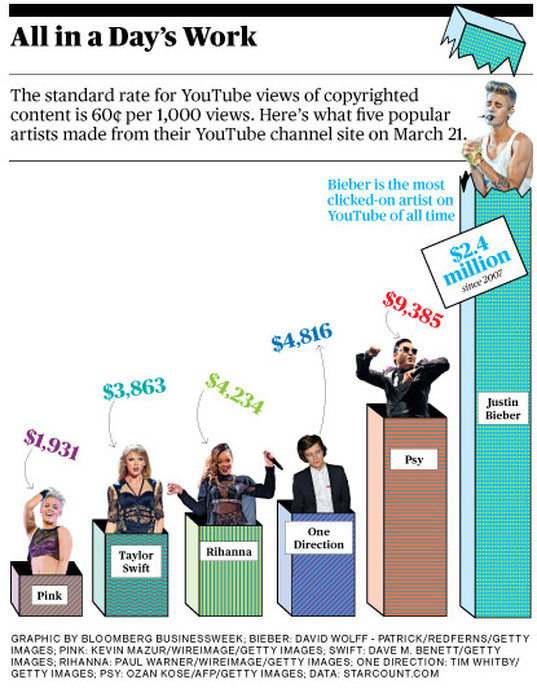 Anyone who thinks they should wait and see how things progress will be left behind in the dust of societal, economic, cultural, and political change. The job you will have tomorrow may be in an industry that is just being born today. The products, markets and companies of next month and next year may not have existed 6 years ago. Facebook opened its site to the general public just six years ago.
This article is a great testimonial to the power of change driven by technology. Now in YouTube stars are born, serious money is made, and the global economy feels more and more like a neighborhood. A decade ago the record industry’s gears clicked along more or less as they always had: Labels signed up promising acts discovered by A&R scouts, paid those acts advances against future music sales, and hawked that music through a sprawling network of radio programmers and retailers. Today, with album sales continuing to plummet—in 2004, 666.7 million albums were sold; by 2012 that number was down more than 50 percent, to 316 million—labels and artists depend more than ever on touring and merchandise for revenue. Songs are ads meant to help sell tickets and T-shirts, and YouTube is beginning to rival radio when it comes to breaking those tracks. Recognizing this, the trade magazine Billboardrecently overhauled its formula for determining the most popular music in the country, giving YouTube plays more weight. The following week, Harlem Shake topped the Hot 100 chart—the first instrumental track to do so since Jan Hammer’s Miami Vice theme in 1984. Five weeks later, it was still there. Read more at Bloomberg BusinessWeek They have been doing the same ridiculous surveys for year and the results never change. Neither does the corporate response to the answers. Employees want to be better paid. It is no secret that the American worker's standard of living and income has continually lost ground over the past 30+ years. The workloads increases while the wealth has not trickled down and it is unlikely to do so as globalism continues to level the employment playing field. Only the very few types of skilled professionals will be sought after and well compensated. On the other hand, the continuous request for flexibility has shown some improvement over the years as global, distributed teams have increased the necessity to work remotely and at staggered times across borders, as has the increased cost of energy. It seems that having employees work from home saves on energy costs at work. People have wanted the same things since serfdom ended: to be recognized for work done not micromanaged for time put in, to be rewarded fairly, and to trusted and treated as thoughtful, contributing adults not mindless drones.  CareerBuilder Survey Reveals Most Wanted Office Perks and What Motivates Workers to Stay With Companies
CHICAGO, January 24, 2013 – .....A new CareerBuilder survey explores which job factors are most important to today’s workers. More than 3,900 full-time workers nationwide participated in the survey conducted online by Harris Interactive© from November 1 to November 30, 2012. Nearly one-third of employers (32 percent) reported that top performers left their organizations in 2012 and 39 percent are concerned that they’ll lose top talent in 2013. While most workers (66 percent) stated that they are generally satisfied with their jobs, one in four (25 percent) said they will change jobs in 2013 or 2014. How important is title? While upward mobility is a key factor in job satisfaction and employee retention, having a certain title isn’t important to more than half of workers (55 percent). The vast majority (88 percent) reported that salary matters more. Other factors that outrank job title in what is most important to workers are: · Flexible schedule – 59 percent · Being able to make a difference – 48 percent · Challenging work – 35 percent · Ability to work from home – 33 percent · Academic reimbursement – 18 percent · Having an office – 17 percent · Company car – 14 percent Read more 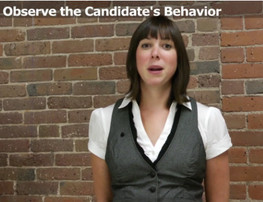 from About.com video coaching interviewers How to Judge Potential Employees on Behavior and Mannerisms This is the title of a video from About.com Human Resources that says,"A potential employees behavior and mannerisms can be the most telling part of the job interview. Learn how to gauge actions and behavior to see if the candidate would be a successful employee."
Hopefully, I have successfully reverse engineered the process advised in this video so that my clients display appropriate interview behaviors to match any interviewer. Our goal is always to do what it takes to turn the interview into an offer. You can always turn down an offer if you think your are not a fit or it isn't quite the right opportunity. But you don't want to hand over that power to the interviewer. You control your total delivery during the interview, not just what you say but how you look, sound and move when you respond. The most scary statement a recruiter can make is to tell you to relax and be yourself. Do not do that! But this does put you on the alert to be very attentive to the recruiter's body language, mannerisms and the non-verbal feedback to the answers that you supply to their questions. That's exactly what they are doing to you! Interviewing as an art should be a well choreographed dance between you and the interviewers. How many times have you lost out on a great position because you didn't read the interviewer correctly or rubbed them the wrong way? Record your voice as you practice answering questions. Use your laptop to video your practice interviews. Microsoft OneNote will actually record the screen as you to this so you can track your improvement. If you get really good at interviewing in any situation, with any style of interviewer, and any company then you can afford to be your self when you want to not when they want you to. 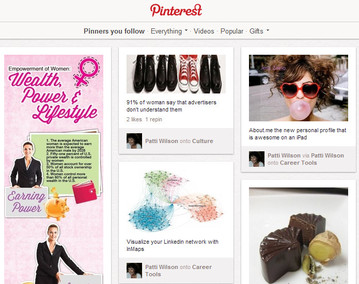 It is so addictive when surfing around the Internet to identify and click on interesting bits of information, articles, news stories with the little Pinterest Pin It button and post an image and link to one of my Pinterest boards.
Pinterest is a visually, discriminating version of Delicious.com, and Stumbleupon. I pick out a relevant image on the article's page, tag it and attach a brief comment/opinion of my own. I use the image to attract your attention to the information and the article. I know that's not exactly what Pinterest intended but it works. Most people put up a collage of clothes, artwork, jewelry, photos, fashion, food, travel, movies and music images. You know, lifestyle. Just look at the Pinterest category list. There is no category for business, the economy, globalization, philosophy, history, politics, careers and jobs, or any of my board titles. Pinterest has self-created its own limitations because it focuses on the image as an end unto itself rather than the means, conduit and connection to an even greater end... the source of the image and attached link. I connected my Facebook profile to Pinterest so that all my pins post to FB. I have had, in just two days, several people comment and repin a number of pins. Now that is cool because nobody comments on my blog posts, except for the occasional spamer. Check out my Pinterest boards on Career Tools, Global Economy, Working Wisdom and Culture. You may get addicted too! 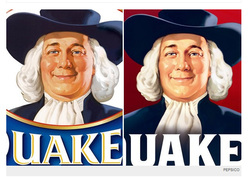 Younger, thinner, more interesting looking is the new oatmeal look. After 136 years, the Quaker Oats guy logo has been updated to appeal to a new generation of young adults as well as appeal to age-phobic baby boomers. If you compare the two logos, yes the one on the right is the new one, the new one shows an updated font style too that is a brighter white and not "old timey" looking.
According to the Time Magazine article, Quaker Oats owner PepsiCo introduced the changes in an effort to make the brand “fresh and innovative,” which might take a bit of doing, given that their product is a dessicated cereal grain. You may not be going on 136 years old, but when it comes to staying viable in the global talent marketplace, well then consider an update of your personal brand. How do you do that? Well it is less the wording in your content which focuses more on branding/rebranding. Rebranding positions you to move into new fields, business sectors, and industries. A brand refresh is gives your current brand a younger, more vibrant, newer, fresher appearance. That is more about image and look. At the warp speed of business and the Internet, a professional look evolves much more rapidly. Digital Documents in 2012 look different from those in 1998 Well, theoretically they should look different but some professionals are still using resume formats and layouts since before the faxed resume. Resumes, websites, blogs, or social profiles are built now to look great on a screen as that's where they are read. In fact, if you go to the Way Back Machine (Internet Archive) and check out early Linkedin, Amazon, blogs sites, you will see how different and dated they look now. The fonts now must take into consideration how well a font renders online and on a screen. Just look at the different in readability between the two Quaker Oats logos. Modern sans-serif fonts look younger and fresher. Serif fonts like Palatino render better onscreen than the traditional Times Roman, making for a crisper, fresher look. The layout and design of all documents are moving to a lighter, more open look. Just look at the new Google Blogger with dynamic, open blog that is image focused versus the blog you are reading now. The older you are, the younger your photo style Most executives use their photos provided by their company's PR department on Linkedin and for other business requirements. If you are over 50 and not working in government and financial services, this is not a good idea. More stable, traditional business sectors like seeing their executives in suits and business attire as does consulting services. There is a reason for the slang referring to "the suits". Using photos taken outdoors, in natural light, preferably in business casual will create an image of health, vitality and youth as well. Business formal creates age aura. If you have substantial career credentials and achievements, then you don't need to look the part as well. Take the photo one step further and be in dressy sports on a wind swept beach with a Golden Retriever. Lacking ocean, use a park and a poodle, or ski slopes, etc. Just don't look too much like you're into extreme sports. Remember how the category "interests" was put at the bottom of your resume and you got to list things like: biking, skiing, marathon running, etc etc? Well, one well done photos creates the better impression of you without the ubiquitous laundry list. Update your look, wardrobe, and appearance There is age discrimination and it is subtle, unconscious, and hard to prove when practiced in hiring and firing. In a media marketing driven, consumption based culture, we are manipulated by the image and look of products which are presented with an emphasis on sex, power, fun,and excitement. Yes, we like functional too, but we get sucked in by looks first. Think how many people wear those ergonomically uncomfortable, auditorially poor, and, basically, cheesy Apple iPod earbuds because they look cool and recognizable in white. A style makeover may not be annually necessary but every five years it is mandatory. This includes product: skin care, hair care, and body maintenance. There is a reason sites like Dermatologistrx is thriving online, and why both men and women no longer consider facial peels and lifts optional. It is not about looking younger which may be hard to archieve, especially after a certain age, but looking fresher, more vibrant and vital. The Quaker Oats guy looks thinner, healthier, and a bit younger and you should too!  There are known knowns. These are things we know that we know. There are known unknowns. That is to say, there are things that we know we don't know. But there are also unknown unknowns. There are things we don't know we don't know.
Donald Rumsfeld I laughed when the then Secretary of Defense made that statement as it sounded like a military-speak aphorism. But, it rings with profound wisdom the more I deal with career management and employment issues in this economy. How do we deal with the business and career issues we don't know we don't know? I advise my clients to do deep research on companies for interview preparation, but that never, within time parameters, uncovers sufficient information to make a well reasoned decision on an offer if one comes. Sometimes it is the luck of the draw that you land well. What do you do with networking referrals devoid of context or personal engagement? You are left in a vacuum to deal with the referral and in the dark as to how to proceed. Time is so precious. You know it if you are in a driven high-pressure position, in career transition, or an entrepreneur. There isn't enough of it, and your living comes from the finite amount of time that you can dedicate to your business. We don't have time to be sidetracked with the unknowns that we don't know. What's worse is that we don't know what we don't know until it is past tense. Often in retrospective, we can look back at an entire situation and see what we needed to know at the time. I believe that is the Monday morning quarterback syndrome personified. Unfortunately, I don't know what to advise you as I don't know what you don't know. But I do have a few mental guidelines that help me and I am happy to share them. Everyday is Groundhog Day Remember the Bill Murray movie where he relived the same day over and over again until he actually had no unknowns left to figure out. Seriously! He ended up knowing everybody in the town and everything they were going to do that day. His level of response by his final rerun day was masterful. I try to remind myself that every day is essentially the same. Within each day there will always be unknowns that are unknown. The result of that attitude is not ending up feeling blindsided as I have already factored that in. When I stay very attuned and mindful I can almost sense them coming out of left field. It is comforting at least. Belts and Braces The British, bless them, had an unspoken rule about being prepared for the unknowns in life. Back in Victorian times and the early part of the last century, men work both a belt and braces (suspenders). Over time and the era of spandex and jeans below your butt, the braces have fallen by the wayside. But belts and braces represented a way of approaching life. The message is clear, expect catastrophe and be doubly prepared: keep an umbrella in the car, hide a house key under a rock, back up your files...twice. You may never need to implement plan B but it's good to know that you can. Think about it. That's why we have a Vice President of the United States. The Morning After the Night Before Letting decisions stew a bit is a good thing. Figuratively, "sleeping" on business problems and issues allows time to have more information unfold and it diminishes the number and size of unknowns. There are certain Myers Briggs personalty types that are really in their comfort zone when they get things decided, goals set, and marching orders relayed to the troops in an expedited fashion. They rush to judgement and freak out when the other shoe drops with unforeseen catastrophes. Other personality styles prefer to put off decisions and just let things unfold. Often that is the best remedy for those blindsiding unknowns. Just let them sort of slide into view rather than dropping on you. Embrace the Unknown The greatest adventures, opportunities and joys in life are most sweet when they have not been predicted, expected, and factored in. Aren't the unknown unknowns often some of the nicest, best surprises that come upon us. We just think that any unknown will be necessarily be bad, negative and undesired. If life is like a box of chocolates then it helps to be an epicurian with a broad palette. Thus you are delighted with whatever you find in the box. The unknown unknowns will always show up in our lives. The impact they have depends on how we choose to experience them.  What is worse than job interviewing in person? Interviewing with a bad webcam using a poor SKYPE connection. You end up with the goldfish bowl look because of the camera distortion. Or your eyes are always looking down at the screen at the interviewers to whom you give no eye contact.
The fine art of interviewing is not improving anytime soon. It can still be a painful, dreaded, nerve-wracking experience on both sides of the desk. Everyone has a nightmare story about the "interviewer from hell", someone who was so bad at asking questions that you absolutely knew you were never going to be hired. What about the interviewer who doesn't ask questions but rather just chats as the new best friend that you never hear from again? Or, the interviewer who asks questions so unrelated to the job you wonder if you applied for the wrong position? Then there is the distainful interviewer, who acts as though it is a supreme imposition just having you in the room. I could go on and you can in the comments section to this blog. How Do You Ace It? Yes, bad interview stories are abundant. However, it still is on you to acquit yourself well during the interview. What does that mean? - Should you ace all the questions with absolutely appropriate answers? - Should you offer great, relevant examples, facts and figures with glib ease? - Should you mirror the interviewers body language to make him/her comfortable in your presence? - Should you create a dialogue to interact in easy conversation, thus putting your interviewer at ease? - Should you provide business solutions to demonstrate the compelling value in hiring you? Yes, of course, to all of the above! But, while that will certainly go a long way to getting you hired, that's not it. If you do everything above, unless you are a glow-in-the-dark java software developer, it is not enough to be hired. And, if you do just some of the above with a less than stunning acquittal of your expertise and you successfully do one more thing, odds are that you will be hired. The Mountain Dew soft drink brand dissolved a legal challenge from a customer who claimed a mouse was found in his can of the "Dew". The company argued that would not be possible as their product would have dissolved the mouse in less than a week. Coca Cola has the same reputation with pennies.
This does not explain why I continue to drink this stuff but it does make an analogy to the act of appreciating. When we appreciate and acknowledge others it has the same corrosive effect on rancor, resentment and grudges as the dissolving of a mouse in a cola can. Appreciation dissolves low morale, under performance and obstructions inside a company. This article in the Harvard Business Blog describes this in more detail. One quote sums it up how appreciation is an antidote to a toxic organization: "The impact of negative emotions — and more specifically the feeling of being devalued — is incredibly toxic. As Daniel Goleman has written, "Threats to our standing in the eyes of others are almost as powerful as those to our very survival." Read the entire article here. Google+ has the quality of adult audience that Linkedin has with the ease of conversation, collaboration and connection of a Facebook. But, it has an interface and setup that is 100 fold better. Currently by invite only, if you know my email address request an invite from me, it has over 20 million users. At that rate it will reach 100 million in 5 months. It took linkedin.com 5+ years to do that. Watch this fun video for a compelling argument why you should join now not later. Whenever M&As happen everyone always speculates on the manpower outcomes. Who will stay and who will go. Often a smaller acquired company is left to be a wholly owned subsidiary with its management intact until something goes wrong or changes dramatically. That's what happened to a company where my client is interviewing for the CEO role. It was geographically distant from the parent company. Further, it was bought for both the technology and the talent who could deliver it.
It's a small unique engineering company located in central California. The founder sold it to a well-known company in Kansas and stayed for 4 years to ensure a successful transition. Now the search is on for a new CEO. Here are the search challenges:
There are moments when retained search firms earn every dollar they charge. This was one of them. Several candidates were put forward and rejected prior to my client. My client and I prepped for the in-person interview with the search firm. Here are the interview issues we addressed:
The interview is not about the product and service of the company. It is not about how skilled and experienced the potential candidate may be. It is about corporate culture, values, and emotional intelligence. All soft stuff, very hard to probe within the context of an interview. Better to spend time the company and candidate together to get to know each other over lunch, dinner, group meetings and on-site trips. It is a career derailer to take a position that is not the best fit for you at this level. Nor should a company hire at this juncture a CEO that doesn't have a 90% chance of success. It is a crucial transition in the acquisition process when the old management steps aside. The entire success of the company can hang in the balance: wittness the fiasco of the MacDonalds - Boston Market acquistion. Finding and hiring the best talent is always a challenge but a Merger & Acquisition situation makes it especially a deal-breaker. Too often I have seen executives come out of specific corporations noted for their strong cultures and not do well in adjusting to a radical career move into a much different culture. I read in Deal and Kennedy's book, Corporate Cultures, that the founders of an organization set the tone and the style of the culture.
I suppose this is obvious when you look at companies with notable CEO's such as Apple's Steve Jobs, Berkshire or Hathaway's Warren Buffet. It is less obvious to connect the style of IBM to Thomas Watson the primary CEO who grew the company from selling typewriters to a computer manufacturer. Can we see the imprint of Henry Ford anymore on Ford Motor Company, or of Christian Dior on the House of Dior? It seems the farther was the organization is from its early roots and founder in terms of time and even geography the more imperceptible the origin of the culture becomes. I mean where is Erle P. Halliburton's ghost now that the company moved to a new HQ in Dubai? Nevertheless, the imprint of custom, tradition, and personality remains in how the employees conduct business, interact with each other and the world. A former hedge fund and derivatives operative from a prominent, infamous investment banking firm inquired about my services. The dynamics of the process with him was interesting. Once he determined that he wanted to engage my services he started to negotiate the deal. To him it was just a normal business transaction and his way of doing it. He started on price, even though I offer multiple packages at different flat rates that are substantially lower than my hourly rate, he tried to haggle over my fees. When that didn't work he turned to terms and conditions by trying to combine multiple packages and extend the time spent by breaking down sessions into 30 minutes each...all, of course at the lowest rate. I decided not to work with him as our styles just did not match as he comes from a culture that is deal driven and so he is and I am so not. The moral of the story is that we all come from multiple unique cultures, not just your family of origin, but your professional field, and the organizations where you have been employed. Developing your awareness to your personality and behaviors traits enable you to make better "fit" decisions when evaluating your career options. |