 The Linkedin headshot has given many people consternation. If you have been on Linkedin long enough you have seen the range of portraits from cartoons to the chiaroscuro mood-invoked Rembrandt headshots. I have seen people do really some really poorly branded photos from passport images to overly dramatic poses. Here are some basic things to consider when using a photo on Linkedin:
1. It is not optional. Weird ideas fill a void. If you don't have a photo, then viewers of your profile will use their imaginations to create their own image of you. Leaving people to their imaginations usually is not in your favor. You will inevitably disappoint in person. 2. About disappointing in person, use a realistic image of you that is relatively current. Over ten years? Hair dyed a new color or fell out? Gained or lost 40 pounds? It is time for a new photo as you will most definitely shock in an in-person meeting. This is definitely a "what you see is what you get" situation. 3. Dress appropriately for the audience and the business demographic you are targeting. If you are looking for business or a job in tech then dressing in a formal dark suit and red silk tie might be off-putting when the business dress code for the company is yoga pants, jeans, and hemp shirts. This is probably the most important tip as to how you are dressed creates a first impression that is hard to erase. Plus, take off your tint-adjusting glasses when outdoors. 4. The setting and pose is a question of relevance. If you are in law enforcement, outdoor sports, or any risky business then a skydiving shot of you at 9,000' might be a great pose . In chartered accounting, banking, brain surgery, maybe not so much. Same could be said for the really cute pose taken at Burning Man or Coachella. Keep your personal life off Linkedin. 5. Look forward at the viewer or towards the center of the screen. This is crucially important now that Linkedin has moved photos to the left side of the screen as you view it. If your body and head are facing out to the left as well, the portrait image creates an unconscious psychological dissonance with the rest of the layout. 6. In the same vein, the background color and view can add or detract. An all white background ranks higher than the ubiquitous corporate photo gray or worse Hollywood black. White is young, edgy and won't fight with your Linkedin background banner that hopefully, you have customized (a topic of another article). 7. Finally, look happy...not cool, inviting, engaging, business-like, professional, or a leader (whatever that is), Just be happy when the shutter snaps. Happiness is contagious and welcoming to everyone. Trust in the portrait-making process,and hire a professional photographer, not your wife or partner. Pick a decent background and outfit. Don't worry, be happy..
18 Comments
 I review and rewrite resumes every day. It’s fun and similar to taking a diamond in the rough and polishing it to reveal the inner brilliance and it is the same with a person’s career. Over the years, I have noticed that too often resumes fall short of adequately presenting a person’s brilliance. People seem to write their resume as either a list of competencies or accomplishments but rarely as achievements. What’s the difference, especially between the last two? A lot. It is enough to make the difference in gaining an interview or a recruiter's attention. At worst, a professional is inadequately branded and doesn't show their best potential. You tell me which category does your resume fall into? Competencies Resumes Technical people tend to list bullets of competencies either hardware, software, tools, techniques, or applications. This is true of all types of engineers, accountants, doctors and other health care practitioners, film/video/audio engineers and producers, as well as programmers, oil and gas and manufacturing types. It is so easy to write lists of competencies for these specialties. It is natural to itemize the tools, methodologies, procedures, and techniques in these fields. Anytime you have a list of things you have mastered and know how to apply and use, then a competency-driven resume is the result. They aren’t bad but simply incomplete as they tend to be strings of words without being attached to a task or action with a beginning and end e.g. an accomplishment. You don't stand out with a list that can be checked off. Accomplishments Resumes A short reach beyond a list of competencies is a list of accomplishments. Most seasoned professionals can do resumes like this with ease. They tend to be historically written in reverse chronology. Accomplishment bullets are set in time with a beginning and end of a task, job or project. These bullets are complete sentences that start with action verbs such as designed, delivered, sold, produced, wrote, managed, etc. Of course there are thousands of action verbs as there are tasks to complete, jobs to do, and projects to finish. Some professionals are so adept at delineating and capturing every action and task throughout the course of their job that the bullets trail down the page overwhelmingly. Accomplishments can be simple or very demanding being completed in a short time-span or over a long period. For example, conducting and completing clinical trials for a new drug can take months to accomplish. This type of resume may be sufficient for an entry level position or an individual contributor. It is not sufficient if you seek more responsible roles that entail leadership, decision-making, and responsibility as it lacks achievement. Achievements Challenging and prestigious are often words used to describe achievements. Achievement implies reaching goals. The difference between accomplishment and achievement is subtle but distinct. For example, completing a series of clinical drug trials is an accomplishment of a project or task. Completing those trials in a way that expedited the drug’s successful approval by the FDA for commercial distribution that will grow the company’s profits is an achievement. An achievement statement on a resume is quantified in some way by demonstrating data, naming names, and using words such as increasing, decreasing, growing, expanding, approving, containing, innovating, improving, succeeding, etc. Turning accomplishments into achievements ties the efforts of tasks and projects into overarching results that impact the organization. Writing a resume that ties your contributions to the greater good of the company is integral to building a professional brand and growing your career. You incrementally grow your reputation one achievement at a time.  I was thinking about a potential client's request to see samples of professional websites that I have done. They thought that building their brand was as easy as copying a site of someone one in the same profession. I guess that's half true. Nowadays, anybody can build a website for free as exampled by a 10 year old using Weebly http://addiesrainforest.weebly.com/. Wix, webstarter, Yolo, Squarespace can also do the job.
Of the 100+ websites I have done for professionals since 2009, My fee was never for the actual building of website, though it was included with the end product. Actually, the need was for unique branded content that put them on the cyberweb in the most favorable light. This is the crux of Web 2.0 and online personal branding that has someone wanting to talk to me. Today, a faxed, mailed, or emailed resume is the mere beginning of a brand, and cannot begin to address personal branding. Linkedin and social media have been the game changers in the past 10 years. The Internet has birthed online branding as a complimentary adjunct to a networked job search. This has challenged everybody, especially executives, in today’s global economy to step up their game and tell a good story. A good brand combined with a solid network are the real job security across companies, borders, and industries. How many articles, webinars, and eBooks are out there now on personal branding? Fortunes have been made telling you what to do. But, what to do is not how to do it. Content and telling a good story is strictly personal. Looking at other people’s self-marketing won’t help you determine and create your own unique value proposition that articulates solutions to re-position or better position you in the marketplace. A well done, integrated brand tells your story in an engaging and appropriate way across digital platforms. Thus, your website's solutions page echoes your accomplishments on your resume and longer story on Linkedin, and they all are further elaborated on in your blog postings. It is a orchestrated effort to build thought leadership, make you stand-out, and be differentiated from others seeking the same opportunities. Bottom-line, why should you be considered? Your brand tells that story. This sophisticated positioning and personal branding is where a good career coach should be able to help you build and tell your story, and it is why executives seek my services. I help you to develop your branded content across platforms, and rebrand yourself to vie for new opportunities. And, you can’t afford to not get it right the first time. There are no second first-impressions on the Internet.  Sometimes it seems nigh impossible to move the dial on an established, but obsolete, traditions like applying to a job posting and spreading your resume all over the Internet to find a job. The article below confirms this with statistics. It doesn't matter that more management and executive level professionals get hired through their networks than through job postings annually. That executive search consultants account for less than 10% of the executive positions placed annually in the USA. It doesn't matter that even before anyone sees your resume, they will see your social profile first. And, even if they get your resume first, they will look you up on Linkedin and search you out on Google to get tmore depth about you. And when they find something they don't like online, more than 50% of the recruiters surveyed say they drop you from their candidate list. People persist in using their resumes to apply to job postings. Why? Because it has always been done that way and because when it comes down to the actual interview, HR wants some kind of document to provide to hiring managers for reference. When will the transition to social profiles and personal websites take hold? If Linkedin has anything to say about it, it will be sooner not later. LinkedIn survey details 'new norms at work' Matt Kapko May 8, 2015 A new survey of 15,000 LinkedIn users with fulltime jobs, 1,000 of which reside in the United States, draws some interesting conclusions while also reinforcing common perceptions about the "new norms" within the modern U.S. workplace. More than a quarter (26.6 percent) of the people from the United States who were surveyed said it's important to maintain separate social media profiles for work and personal. One in five U.S. respondents (20.5 percent) said they make initial impressions based on a person's online profile picture. And one in 10 respondents said they worry about what their colleagues may think of them based on content they shared on social networks that may not seem professional, according to the survey, which was conducted by Censuswide for LinkedIn during the first week of April. Catherine Fisher, LinkedIn's career expert, says the findings stress the fact that people need to be mindful of how they portray themselves on social media. The U.S. responses also highlight notable difference between women and men in the workforce. Almost a third (30.9 percent) of women respondents said they are friends with colleagues on non-professional social networks, while only 16 percent of men said the same. Nearly a third of the women (32.5 percent) feel as though they're judged by what they wear to work, and more than a quarter (26.8 percent) said they believe men have it easier when it comes to the threads they don at work. And more than four in 10 women (41.6 percent) said they tend to dress up more when they have meetings during the day, while only 25.5 percent of the men step up their dress for meetings. Work experience, education and volunteer history are the three top factors U.S. users weigh to gauge a colleague's LinkedIn profile, according to the survey. More than one in five (21 percent) of those surveyed from the Unites States said it's more appropriate to self-promote now on social media than in years past. Almost 13 percent said they feel more comfortable sharing their opinions on industry matters via social networks, and nearly 9 percent think doing so is a great way to raise their professional profiles. Perhaps most surprising of all is that only 12.8 percent of U.S. respondents think a good LinkedIn profile is just as important as a good resume.  Last year, Linkedin opened up postings to the general membership. Prior to that time only Influencers (famous people, leaders in their field) designated by Linkedin were allowed to write those short, pithy articles that accumulated and archived on their profile pages. The rest of us had been relegated to ephemeral Linkedin Updates that disappeared into the news thread once posted.
In July of 2014, the little pen icon appeared on the update box, and intrepid trail blazers began posting on their Linkedin Profiles. What is a post exactly? On Linkedin, a posting is short article, essay, or observation on a topic of your choice with an accompanying image. The posting image along with an attention-getting title are important because your posts will be displayed on your profile by image and title as well as sent to all your first degree connections. Further, if you have written an interesting post that attracts Linkedin’s attention, they may choose it for redistribution to millions of Pulse subscribers, the site’s in-house news magazine. What you have to say might just be the differentiator for success depending upon your career goals and employment circumstances. Aside from writing posts because they attract attention to your profile and raise your visibility on the site, there are three compelling career motivators to do it as well. 1. Thought Leadership Build and demonstrate your knowledge and expertise in your current business sector and professional field. Anything you do outside your company will reflect back positively inside your company. Writing on your observations, insights, and unique perspective improves your stature in your field. Your post’s topics can open doors to consulting opportunities, creates visibility for potential board positions, and generates invitations to speak at conferences. You can position yourself as the go-to expert for media interviews. This all becomes a virtuous circle that continues to build on your reputation within your field or business sector. 2. Career Transition Making a career transition to a new industry more often than not requires some background in the new sector. That experience is the unspoken key criteria in a recruiter’s search that could be the deal breaker when it comes down to the choice between you and another candidate for a position. Hands-on experience is not always easy to come by up front, but postings helps build the bridge to the new industry or sector. Write about where you want to be not where you are. Write about the companies that you have targeted for employment. Yes, it takes some research and digging, but then you will be better prepared for interviewing. You will have demonstrated your knowledge up front, and established your credibility in advance by easily accessible postings on your Linkedin profile. 3. Gaps in Experience Writing on topics that are gaps in your knowledge or experience can move you past objections for a promotion and enable a career move. Rejection for employment and promotion typically lies in a skills or experience gap that doesn’t enable a complete “fit”. The bigger the company the less likely they are to overlook that. For example, you may have a solid background in retail marketing for bricks and mortar entities but no experience in e-commerce. Or, you have been a CIO for a very traditional company who had no need to use big data, data analytics, and social media in their business. Whatever the gap, the missing hands-on experience can be supplemented by writing posts about various aspects of it. Rather than trying to sell your value proposition past that gap objection during an interview, write about it in advance to leverage your credibility. Since 2008, Linkedin has gained critical mass with now over 1/3 of a billion members. It is the 800 pound gorilla in the job search room. What it decides to do in terms of their profile presentation, content and style drives the modern-day professional’s career marketing and branding initiatives. This is not to be trifled with as hiring decisions are rarely made now without at least a glance or even longer review of your profile. Worrying about privacy and jeopardizing your current employment status should be a non-issue now. The loss of momentum in your personal marketing out- weights your employer’s critical judgement. Once you have a robust profile in place, as your career progresses it is easy to use it to enhance and facilitate your success.  At a certain career stage, rising young professionals want to know how to be appointed to a board of directors. Unlike a job hunt where you should be the active party seeking a position, a board seat is supposed to come to you. There are, however, some things you can do to help the process along to gain a seat at the table.
Keep in mind that you have to be at the right level for the size, scope and type of enterprise seeking a board member. A small business owner might be invited to a local non-profit board in their town simply by starting to volunteer. But, a corporate executive would more likely be on a regional or national non-profit board through business colleagues. Board positions of privately held or public companies are a greater level of difficulty to achieve as your network needs to include those decision-makers and stake Here are some tips to get you onboard:
It is tough getting on boards. The small startup companies want people with either access to venture capital and private equity money or star power in the field. The mid-sized and big public companies want experts and top executives to guide and support their company’s top executives. Private company boards, especially small ones, tend to be an inside job, in that the board members are family, friends, and members of their support system. The best strategy is ongoing networking in the right place with the right people, so that eventually it is the right time for you to be asked.  Selling a service is like selling heroin...you need to get your customers rapturously hooked. Linkedin is the consummate example of this. When you think of your job search and how you present yourself, are you offering engagement with a set of services or are you presenting you, the product?
Seems to me that the more valuable course would be to present services to a company that they can partake of through a free advisor role, short term immediate consulting, or a longer term engagement. Thinking not about you the candidate to be hired as a product frees you to creatively present scenarios where engagement is win win for both you and the company. The Product-Service Shift – Transforming Your Operating Model by Geoffrey Moore (via Linkedin Pulse) As digital devices, cloud computing, and smart phone apps permeate more and more of our interactions, the product-service shift is overtaking more and more of our economy. This is a good thing from the point of view of lowering barriers to adoption and delivery costs, but it is a real challenge for vendors to transform their operating models to leverage the new infrastructure. A big part of the problem is simply getting our heads around the new paradigm. So much of the language of business is stuck in the old vocabulary, and that is causing us to make wrong choices without even knowing it. Let me show you what I mean. Take the combined notions of product marketing and product management. In a product company, although we often argue whose job it is to do what, we know overall what scope of work is involved. You have to spec out a set of features customers want, work with engineering to get them built into the product, work with marketing to get the product promoted, work with sales to get it sold, and work with customer support to get it serviced (and to collect a set of enhancement request for the next spec). But that is not at all how a service business works. Service customers don’t want features, they want outcomes. They don’t trust marketing that is outside the service experience; they expect to learn, try, and buy from inside the service delivery envelope. They don’t expect to be sold to, nor do they expect to use customer support unless somehow the service fails to deliver, which is more likely simply to cause them to churn out. So product marketing and management now equates to creating a completely contained environment within which both the prospective customer and the service vendor can experiment with each other across a digital interface to see if they have something of value to exchange. In this model there are no product releases. That is an obsolete notion that radically disrupts the low-latency give and take of a digital service engagement. Instead, the rhythm of that engagement is set by the spinning of four gears—Engage, Acquire, Enlist, and Monetize—all of which happen inside the service envelope. That means that engineering has to design and build the marketing directly into the service infrastructure, including whatever branding is needed. And the whole thing has to be built to evolve as A/B testing teaches us all what’s to, or not to, like. And that brings us to the freemium business model, in which there are no free trials because that concept implies that, if you like the trial, you will buy the product. That is not how a service model works. If you like the product, you will continue to engage with it, for free! Only after you have engaged deeply enough to be interested in a greater level of service can monetization be introduced. Here again the product mentality creates the wrong mindset. Product thinking says withhold the really valuable features, or give people a thirty day window, or do some other semi-coercive tactic to give you leverage in a purchase negotiation. These are dumb moves in the world of digital services, where losing the lifeline of user engagement costs you much more than continuing to support free. You have to learn how to woo rather than to bargain. And when it comes to purchasing, we think we want consumers to sign a license agreement, but that is a product concept designed to put power into the hands of the product vendor. What we want service customers to do instead is activate an account, something that keeps the power in their hands while creating a medium by which they can indeed spend money with us. The verb here is activate, not install, and our customer servicer outreach has to be structured accordingly. Similarly, when it comes to training, there can be no training. That is a product concept. Instead we need to orchestrate an onboarding process, one in which the user is guided through an experience instead of explained the intricacies of an interface. That’s why the hot new job title is called user experience design, no longer user interface design. And so it goes. All language is metaphorical to some degree. It is amazing how little it takes to put you in jail. Everywhere you turn it seems the legacy of a product-anchored vocabulary is insinuating itself into our thinking, leading us to make choices which are at best irrelevant and at worse self-defeating. So let me encourage you to engage your team in a language acid bath experiment, the goal of which is to root out as many product-centric phrases as you can and subject each one to a ruthless analysis of its implications, and then find a substitute phrase that will get everyone onto the right track. I think you will be shocked by what you find. Either way, I hope you report back. That’s what I think. What do you think? _________________________________________________________________________ Geoffrey Moore | Crossing the Chasm | Geoffrey Moore Twitter | Geoffrey Moore YouTube 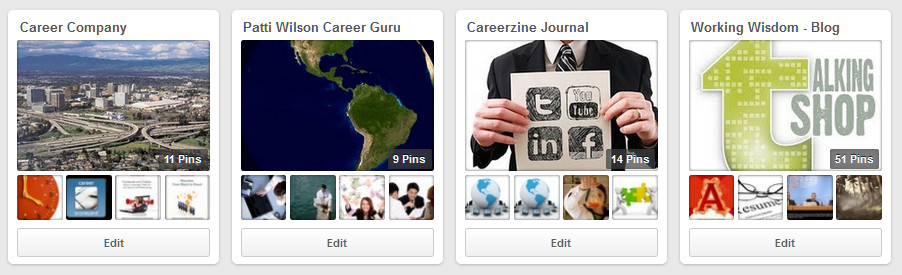 The Pinterest boards for my websites and blogs Image-driven content online is not just for selling and promoting products and retail entities. Professional services and, by extension, professional profiles online can and do benefit from images. Images are enhancers we can no longer afford to ignore as we create digital content and promote ourselves online.
Look at the trend on Linkedin to images in profile backgrounds, post images, group logos, and slide decks. Your Linkedin Groups page now shows each group's logo as images going down the screen similar in look to Pinterest's boards . Image-driven content, unless you are a products company or retailer, is a waste of digital space, bandwidth and scrolling time. However, great images succeed and are equaled only Buzzfeed's catchy titles in attracting viewer attention. Content may be king but images rule. Taking every opportunity to use image-driven content is crucial for professional promotion, online branding and visibility. Pinterest represents the opportunity for professionals to extend brand visibility and promotion using their boards to post images of blog posts, website pages, and self-images. When the Wall Street Journal first started posting their articles on Pinterest, every article they posted from their paper featured their boring grey logo. It was a sea of gray going down the screen with no differentiation of the articles except by title. Their titles were not Buzzfeed quality. In less than two weeks, they quickly read (or saw) the tea leaves and started using amazing images and photos to engage viewers and drive traffic from their Pinterest board posts to their website. Of course the obvious, practical profitable application of Pinterest boards is by Etsy members to attract attention to their products and drive customers to their Estsy store page for purchases. However, we professionasl can expand our digital footprint by setting up Pinterest boards for our website, blog and Linkedin posts, and other social-content sites. Each new page or post is then "pinned" to its respective Pinterest board by the image. The images above are from my Pinterest boards for my websites and blogs. Pinterest's image-driven content boards are a free online billboard that drives traffic to a website or blog or social profile for any professional. In addition, a presence on Pinterest can improve your Google name search ranking. And, of course, we all want to be found online. Start thinking about how you can transform your boring white papers into image-driven 200+ slide decks. Not many people are priinting out documents to read today when it is far quicker and easier to graze the information on your tablet or smart phone. Hence, the movement towards succinct delivery of information with images. Start rethinking your next boring 3 bullet powerpoint slide presentation. Re work it into a smal visual ebook instead. Or would you rather read formatted as an article? Note each sentence is a slide so instead of a short article you get to zip through a fun and interesting 70 slide deck. Launching a Career Comback, Linkedin Blog Post
How to Rock the Perfect LinkedIn Profile from LinkedIn Matt Henshaw June 11, 2014 Hello, I’m Matt Henshaw and (like the beautiful Slideshare above shows) I launched a successful career comeback. What does that actually mean? Well, a little while ago, I realised I was doing a job that was not my dream. So I decided to make a change and follow my dream – to become a singer-songwriter and self-sufficient working musician, like I said, my very own career comeback. Here’s my story and how LinkedIn played a part in it. From my time at school to the end of 2008, I was in a band called Censored. What started as a few lads from Nottingham messing about soon became serious. It was a great time – we were even supporting our music heroes, bands like Supergrass and Ocean Colour Scene. And hanging out with the likes of the Kaiser Chiefs and the Arctic Monkeys – what could possibly go wrong? I suppose I never really thought about the future and without any real guidance, we took on too much and spread ourselves too thin. I got burnt out and had to cancel gigs and festivals. Sometimes when you lose momentum, you don’t find it again. I was in touching distance of my dream career – then it was suddenly over. Skip to 2012, I was working as a Computer Science Sustainability Research Assistant – try saying that with your mouth full! It was OK, it paid the bills but it wasn’t my dream. Then I went to watch some music gigs for the first time in a long time. The Stone Roses had reformed and Jack White was playing solo shows with all the joy and freedom that goes with it. And that’s when it hit me – I’m one of these people, I’m a musician, that’s MY dream! I had to get back in. But the music landscape had changed since 2008. And it hadn’t exactly gone well last time. That’s where LinkedIn came in. I thought if this can work for office stuff why not music as well? I wanted to showcase my passion, my personality and make sure people took me seriously as a professional – not just another lad with a guitar. After updating my profile, I soon found endorsements rolling in from my old network backing my music skills. It was a massive confidence boost. Then I found people started coming to me! For gigs, festivals and just putting stuff together in the recording studio. My profile was like a magnet – all because I had added a bit more detail. I now have a gig at the Camden Roundhouse and the Elevator Music Festival. You may be thinking “good for him but I don’t want to be a musician”. Well, that’s not my point. Whether you’re a musician, a lawyer, a scientist or an accountant you can always do better. LinkedIn is for anyone with ambition. It’s not going to magically make things happen for you, but if you want to follow your dream then investing in your profile and having LinkedIn in your corner can only help. LinkedIn played its part for me and it can for you. What’s your dream? Peace, Love & Tea, MHx PS. If you like my Slideshare, why not share it on  The take-away of the article when building your career or making a career move is to get a reputation and visibility ahead of curve. The easiest way to do that quickly by leveraging the expertise, fame and reputation of other professionals.
It's simple really, set-up a blog and interview people working in your current field or new field. Pick the ones with the biggest networks. This creates overnight brand reputation for you as every one you interview will promote the interview blog posting to their network. If you are really ambitious, do a book. The article mentioned, " Remember, people judge how smart you are more on the basis of the questions you ask than on the answers you give". By asking very astute, thoughtful, and insightful questions,you look like an instant expert. Sure you are a thought leader in a month but continuing the interviewing as you expand your network is a long-term investment that maintains your brand in your field and keeps you on everybody's radar. ~~~~~~~~~~~~~~~~~~~~~~~~~~~~~~~~~~~~~~~~~~~~~~~~~~~~~~~~~~~ How to Become a Thought Leader in a Month or Less BY MICHAEL SCHEIN Thought leaders make more money, but getting there can be a real slog. Try this simple trick to become known as an expert in a fraction of the time. Here’s how the Oxford English Dictionary defines thought leader:“One whose views on a subject are taken to be authoritative and influential.” It’s no wonder so many business owners and executives invest millions of dollars trying to attain this status. Today, anyone can find countless alternatives to every product or service with a few mouse clicks. In this sort of environment, only those perceived as experts can truly thrive. Unfortunately, becoming a notable expert usually takes a long time, even in the digital age. Many people assume that if they throw up a blog and publish great content, members of their target market will find it. They won’t. There are literally millions of blogs and websites already in existence. The most successful thought leaders built their audiences by fostering relationships with other influencers they knew could effectively spread their message. Engaging in this kind of intense ongoing interaction can be grueling. Fortunately, there’s a way to shortcut the process. Target Your Own Circle FirstIf you’re a driven entrepreneur or executive, I’m willing to bet you have an extensive network of people with substantial knowledge and expertise. Like so much else in the business world, your personal network is the ideal place to begin when establishing yourself as a thought leader. Read full article here  I have been preaching from this hymnal for so long now. All my clients have not just robust social profiles but websites, iPad profiles, and blogs. Every profile and site is well curated and managed for image and reputation. Soon everyone will wake up to this and forget to angst over their resumes which nobody really sees in comparison.
Why would you worry about your employer seeing you? They are online touting themselves too. Linkedin is even encouraging high school students to join them now. ~~~~~~~~~~~ Your Web Presence Will Soon Be More Valuable Than Your Credit Rating by Philip Brewer on 5 February 2014 reprinted with links from www.wisebread.com When employers first started looking up their potential new hires on social media sites, recent grads started deleting whole Facebook accounts. That was better than having a fully documented history of bad behavior, but in the near future people are going to have to do a lot better. A blank social media history is going to be a bad social media history. (See also: 9 LinkedIn Changes You Should Make) The whole situation is directly analogous to credit ratings. Time was, a lot of people didn't even have a credit history — back when credit cards were a way to borrow money, rather than a mechanism for making payments. Plenty of people were proud that they'd never had to borrow money — figured it showed that they were responsible money managers. And often those same folks were terribly surprised when it turned out that having no credit history made it tough when they did want to borrow, such as to get a mortgage. The reason was simple: lenders wanted to see a demonstrated capability to make monthly payments on time, and people who had never borrowed money didn't have a history that showed that. (See also: How to Build Credit From Scratch) Very soon, having no online presence is going to be worrisome in just the same way. It's going to either mean that you're a complete nobody — or more likely, that your past behavior was so bad you couldn't clean things up by just deleting a few unwise posts. Building a Good Web FootprintThere used to be a lot of articles on how to build a good credit history. (The advice usually boiled down to: borrow a little money, make the payments on time, make the last payment a little early.) Now it's time for some similar articles on how to build a good web presence. We don't yet know what's going to be most important, but here are some ideas on how to get started. Be GradualYour web footprint should be built gradually, with posts spread out over time. Don't imagine that you can fake up a whole web history in a day, or even a few weeks. (For one thing, too many of the posts have hard-to-fake timestamps. But even aside from that, it's just hard to make up anything that has the richness of a real person's life, except by documenting it day-by-day.) Be NormalYour web footprint should make you look like an ordinary person, with various interests and a reasonable number of friends. A nice mix of posts — some quotidian updates liberally laced with quirky vacation stories, some links to interesting articles, photos with friends and with family, likes of local businesses — is going to look much better than two hundred posts all on the same topic (even if the topic is relevant to the job you're trying to get). Be ConnectedYour web footprint should make you look engaged. In addition to your own content, you should like and share other people's content — and you should have content that other people like and share. Don't look like you think you're above everyone else; don't look like nobody likes you. (See also: Why You Should Cultivate Relationships) Be HonorableYour web footprint should make you look unique and quirky — but like a good person. Don't have posts that make you look cruel or abusive. It's fine to have some stories about misadventures, but don't make yourself out to be stupid or incompetent. (Especially, don't make yourself out to be a criminal or a drunk.) Be DistributedYour web footprint shouldn't all be one place. Right now, probably the most important web presence to have is on Facebook, followed by Twitter, and then Google+. But there are dozens of other places where it's worth being engaged: Reddit, Pinterest, Tumblr, Flickr, Delicious, StumbleUpon, your own blog, etc. There's no telling what the next big thing will be. Fortunately, there's no need to be on the next big thing. Just make sure your whole web presence isn't all on one site — a lot of sites are going to disappear (or worse, become a joke for the people who have moved on to the next big thing). A Web Presence Is Cheaper Than an InterviewThe first time I was interviewed for a job, I was surprised at how little time was spent talking about my qualifications, and how much time was spent just talking. Only years later — after I started doing interviews myself — did I come to understand. By the time you get to the interview stage, the employer has already decided that you have the skills to do the work. In the interview, they're trying to figure out if you'll fit in. They want to make sure that you're not a jerk or a flake. But interviews are expensive — and however limited the picture of someone that you'll get from their web presence, it's often enough to spot the jerks and the flakes. (See also: 13 Ways to Make a Good Impression at Your Job Interview) If your web footprint makes you look like a jerk or a flake, interviews are going to be few and far between. But if your web footprint is so sparse that someone taking a good look at it comes away without any strong sense of the sort of person you are, there's every reason to fear that you won't get the benefit of the doubt. They'll just look at the next guy, and the guy after that. Soon enough they'll find someone with enough of a web presence that they feel like they've got a sense of the guy. That's the applicant they'll call in for an interview. Make sure your web footprint doesn't make you look like a jerk or a flake — and make sure it's dense enough that it looks real, and not like the creation of a few days of trying to fake something up (or a lifetime of bad behavior with all the bad posts hidden). Beyond the Job SearchYour web presence already matters in your job search, but soon it's going to matter for everything. Lots of interactions are already heavily reliant on social media reputation — dating (especially online dating, but also real-life dating), doing freelance work, selling second-hand goods, and so on. Credit scoring won't be far behind, and probably getting insurance as well. Time to get ready for it. Are you actively maintaining your online reputation? Has your online persona helped or hurt you? full article here 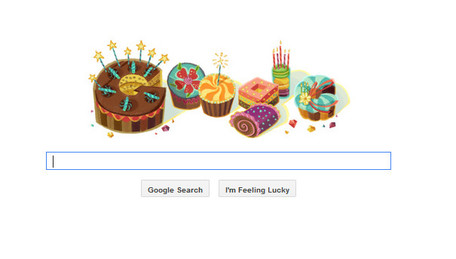 On Google Search Page My Birthday Greeting and Cakes. I Especially Like the Jelly Roll! On Google Search Page My Birthday Greeting and Cakes. I Especially Like the Jelly Roll! And when I moused over the image it said "Happy Birthday Patti"! How cool is it to have a Google Doodle personalized for you? Is this brilliant marketing? Indeed it is as I am blogging about it.
But, there's more. They gave me a present, too! They offered me a personalized URL and of course I snapped it up: https://www.google.com/+PattiWilson Not to grouse over this, but it is about time because a personalized URL is the best way to help drive people to Google+. I haven't seen Google in a hurry to pass them out. In their typical style, they offer products selectively and roll out new services by word of mouth and invitation only. Compare this to the land rush Facebook conducted when it opened up their URLs on a first come first serve basis in one day. Why are these personalized URLs important to individuals beyond mere status symbols? Why have I made a point to get my name in every URL that I can and in every email service offered? Yes, I own pattiwilson in Yahoo, Outlook, and Google email. Well one's name is part of one's brand isn't it? It is how you are found in a Google search. People, hiring managers, headhunters, customers, networking contacts, blind dates will all search on your name in Google not your company. Think about it. You do it yourself when you want to find out about somebody. Moreover, Google's search algorithm gives preference to someone's name + a URL like pattiwilson.com or pattiwilson.net. It really doesn't matter what specific domain comes after it. It could be .me, .ca, .us, .whatever. The name attached to the domain is of key importance. If you have a common name, like mine, then owning multiple URLs in required to hold your place at the top of the first screen in a Google name search. If you share a name with someone famous who is in IMDB or Wikipedia, for example, then it is crucial to have multiple social sites and URLs with your name to compete against the big databases. It all adds up to greater visibility and a bigger digital footprint. What is the point of good branding if nobody can find you online? Thanks Google!  It sure can and has been repeated. I have watched Whole Food gentrify an entire locale all buy themselves in less than 6 years. Now that is brand magic! Status by association, indeed.
Who are you networked with? Who are you name dropping in your CV and on your blog? How can you shine in the glow of an other's radiant sun? There is a lesson to be learned here aside from eating organic and free range. If we worked as hard on our brands and reputations as Whole Foods has then people would want to hang by with us too, and even hire us. Can the Whole Foods Effect Be Repeated? By Kriston Capps Urban-issues columnist Will Doig tackles the so-called Whole Foods Effect in a Salon story about development in Detroit—and well, development in every city that’s seen significant gentrification in the last decade or so. Detroit is the latest—following Washington, D.C., in 2000, Pittsburgh in 2002, and Boston last year—to see a neighborhood jolt following the announcement of the arrival of a Whole Foods. In Detroit, developers are betting big that the Whole Foods Effect will transform Midtown—$4.2 million big, Doig reports. “That figure suggests city leaders believe that Whole Foods is a force unto itself that can give a neighborhood the escape velocity it needs to break free of its doldrums,” he says, and then asks: “Are they right?” Doig writes that Whole Foods occupies a unique position in the food-market eco-system: It’s a debt-free company with 50 new stores coming online. Businesses piggyback off of Whole Foods’s advance work: The company looks for neighborhood areas with 200,000 people (a college-educated set at that) living within a 20-minute-drive radius. That may be Whole Foods’s greatest signal to developers and businesses: They’ve done the math so you don’t have to. The numbers bear out, Doig writes: An exhaustive 2007 study by Johnson Reid quantified the effects that individual urban amenities have on home prices. Using hedonic modeling, it found that a specialty grocer will increase surrounding home prices by an average of 17.5 percent, more than bookstores, bike shops or gyms (with the caveat, of course, that this varies greatly depending on the situation — in the instances studied, the increases ranged widely from 6 to 29 percent). Then he digs into the effect it’s had on D.C.’s Logan Circle neighborhood (which is a stone’s throw from ARCHITECT’s offices): When Whole Foods moved onto P Street in Washington, D.C., 13 years ago, the only nightlife on the block was a divey (and awesome) rock club called the Vegas Lounge. The Lounge is still there, but it’s since been joined by a popular burger joint called Stoney’s, a “food-to-fork” locavore restaurant called Logan Tavern that owns a farm 30 miles south of the city, a Starbucks (open till 8 p.m.), a coffeehouse-slash-bar called Commissary and several retail stores, all squeezed onto the same block as Whole Foods. His D.C. example raises a couple of salient points. One big plus to the P Street N.W. Whole Foods is its design: Its parking lot is small and underground, as it was clearly meant to fit into the neighborhood, not replace a big chunk of it. Many of the Whole Foods throughout the U.S. Northeast, in fact, are designed to encourage walkable communities. Other grocery stores in D.C. looked like the original Whole Foods in Austin, Texas—that is, a stand-alone, big-box grocer with a great deal of its footprint set aside for parking. When the D.C. Whole Foods opened it 2000, it was the only grocery store signaling urban density at the time. Back then, Whole Foods was also one of relatively few grocery stores serving D.C. at all. A Safeway store popularly known as the Soviet Safeway—so named for its frequent shortages—was then the closest grocery store, and that one was a neighborhood away. It’s hard to say whether the Whole Foods Effect is the function of a singular urban-organic-brand signaling, or if Whole Foods is just a savvy company identifying niches in the marketplace. Doig puts this question another way: “Could a Safeway gentrify a neighborhood like Midtown Detroit? Could a Wal-Mart?” Doig says no—but Safeway and Wal-Mart want this answer to be yes. Wal-Mart is opening six new stores in D.C., and the preliminary designs that the company has released for its first foray into the capital look nothing at all like their sprawling cousins in the suburbs. They look like Whole Foods. Chains such as Safeway and Giant are updating their brands to follow; a popular Giant a mile or two up the road from the Logan Circle Whole Foods is known widely as the Gentrification Giant—because it appears to have contributed to (or to have benefited from) the sort of growth that the Whole Foods Effect describes. One thing is clear: When it comes to big-store grocers spurring urban growth, Whole Foods has won the first-mover advantage. Here is the source of this article  Yes Linkedin has a new layout and we all still look the same, but prettier. However, since recruiters are paying $8000 USD annually to find us, let's do what we can to help them. In fact let's make it easy on them.
Here are 5 simple and quick things to implement that will put you in a recruiter's headlights. It will wildly improve your visibility to recruiters on Linkedin. But before you go crazy, on Linkedin go up under your name and click on Settings in the drop down menu to close down all you visibility. You really do not want Linkedin to announce to the whole world every time you join a group or add a contact. Yes, you have to set your privacy as the default is total public nakedness on Linkedin...not good.
These 5 tasks will not take long and the rewards you will reap will be astonishing. Linkedin is really a numbers game to be seen and found. My client who connected to over 500 recruiters on 3 continents in less than a month ended up with 2 interviews. He is at the top executive level so those searches are not plentiful. He got a good return on his investment. Further, every time he posts a blog that highlights his expertise, it goes to his Linkedin updates. His LInkedin updates remind all his recruiter-connections continually of his talents and availability. This is a virtuous circle of creating a reputation and having it be seen on If you want help in building out the content to make your Linkedin Profile really shine, contact me at patti@careercompany.com  Who said you can never be too thin or too rich or have too many diamonds? The whole goal of personal branding is not to limit your exposure online but to expand and control it. Linkedin, other social networks, a personal website are not either or choices. This is not a zero sum game.
Self-marketing online (and where else is it nowadays?) is best done by delivering your message using as many platforms, tools and devices as possible. This also includes a "Presume" on Sliderocket.com and a personal Prezi presentation too. Then link them altogether. How weird would it be if Coca Cola used only billboards for advertising and not TV, online and magazines? Same goes for us. When someone puts your name in google search...not only Linkedin should come up but a whole plethora of branded links about you that you own and control: website, blogs, etc. But, like everything else online, websites are now commodities and therefore cheap, if not free. You can build your own with little talent for design and no money and still have a passable result. I will be better than Linkedin because it is uniquely you. A personal website enables us to truly express our uniqueness compared to template-driven social sites. They all have different purposes. Linkedin and other social sites are first and foremost connectors rather than a branding instrument. There are several cloud services for websites where the building and hosting is free as well is the maintenance. Try www.weebly.com . I build all my client's sites there...since 2009 almost 80. My own business and personal websites and blogs are on Weebly: www.pattiwilson.com, www.pattiwilson.net, www.santacruzcalifornia.us, www.joyousdancer.com, I don't think it matters in a Google search which site is point as people (especially search consultants) are curious enough to look at everything. When I sign my name in an email, I list my title, company, Linkedin, SKYPE, website URLs, my phone number. People usually copy all of it for their Outlook files or whatever. The web is moving towards image driven content and curated content. How better to provide both images and curated content of ourselves than a website? Although I do have my business on Pinterest too. in addition... www.about.me is an online business card that will link and point to all other sites online where your profile and dossier exists. If you can only put one link under your name in an email, then use that site. It is free. The only competitor that I know of to about.me is www.flavors.com . You can do both. About.me is one page and they will provide you will a print business card that matches your about.me profile too. Send me an email if you want to see a rainforest research science project website that a 9 year old built by herself using Weebly or some of the sites I have done. Patti@pattiwilson.com
 Understanding your salary: Are you a pork belly or a sausage?
The quiz in NPR's Marketplace.org brings home the obvious truth about how to get ahead. Yes indeed, we all need to brand ourselves to stand out from all those other pork bellies. But just being a best of class pork belly isn't enough to make more money, be lay-off proof and get ahead. In today's dog eat dog world we all need to evolve into being a true sausage. Whether that is by adding special skills and knowledge to our portfolio, or gaining unique training beyond the average degrees, we need to be able to distinctly be able to separate ourselves by our uniqueness value proposition. If you don't fit into their standard, generic job descriptions you can't be pigeon-holed into a salary range. Having a career description unique to you, like a gourmet sausage, will add to your market value, the salary you can command and, certainly, the demand for your abilities in the marketplace. The quiz, by the simple comparison questions, gives you the path to follow to become a true sausage. I won't be a spoiler and list them. Click on the title at the top or here and go take it for yourself. Then figure out what you can do to improve your differentiation in the marketplace and then how to tell your story so that people get it. Email me if you have trouble: patti@pattiwilson.com
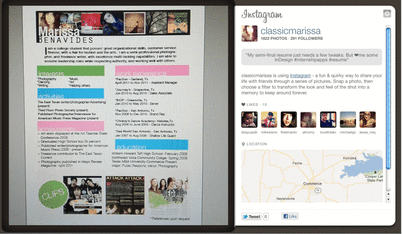 Business Insider has 23 examples of cool resumes using Instagram, the image-based website that Facebook just bought for $1 billion. They said in their intro:
It seems like a boring black and white resume won't get you very far anymore. Inspired by 7 cool resumes we found on Pinterest, we scoured Instagram for some more. Here are the most creative resumes we found. View all 23 here Some of the examples are stunning, others quirky, and all are young...very young. This really can work for you if you are under 30 and fighting for visibility in this very tough job market for early professionals. Certainly it can give anyone in the creative arts, digital media, and technology an extra edge and opportunity to showcase their talents. But will Instagram and Pinterest work for mid-career experienced professionals and senior executives? A qualified yes. It depends on the sector, the role and position level. In heavy equipment manufacturing at the C-level it would not be advisable. At least not this year. But in consumer packaged goods, fast moving consumer goods, hospitality, sports, recreation, entertainment, consumer electronics, fashion, advertizing, and technology sectors, those sites could well be a differentiating addition to your online branding. The position is important too. Traditional fields of finance, insurance, risk management, facilities management, for example, don't lend themselves, right now, to this kind of treatment. This kind of personal branding would not be expected nor accepted in more conservative sectors or professions. With all of the above caveats, in the parade, it is far better to ahead of the elephants and horses than behind. In 2003, when Linkedin launched nobody had ever heard of it let alone wanted to join and connect. Back then it was easy to get thousands of connections (and I did) and now you have to buy them. My advice is to register your name on Pinterest and Instagram to just hold a place for your profile. Eventually they will become acceptable social sites like linkedin is now and you then can leverage them for online branding. See all my blogs and website on Pinterest boards . Instagram is next. 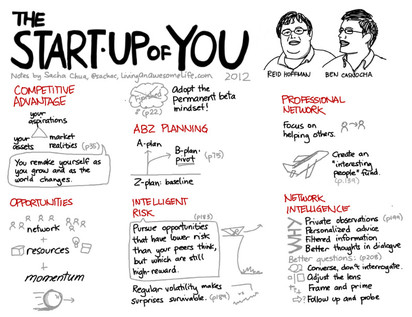 http://sachachua.com/blog/p/23203/ We all know by now about very successful launch of The Startup of You by the founder of Linkedin. It has good tips and advice for the Social Generation's job search.
But that's not my point here. I have been mulling the changes that 20 years can make in how we have careers, look for work and create our success. In 1990, Tom Peter's published in Fast Company, The Brand Called You. During the past 20+ years, people, with the help of the Internet, have figured out and mastered how to brand, pitch, promote and market themselves to get or stay employed. Everybody is on Google+, Linkedin, Viadeo, Xing, and FB pages with profiles describing their accomplishments. Many professionals (all my clients) are setting up professional websites, iPad profiles, and even Presumes. Yes, we have got the branding part down to the point that everyone is sick of hearing the word used. Unfortunately, being well branded, positioned and marketed isn't enough anymore. The Startup of You addresses the really salient career challenges that the Social Generation faces today. How do you find a job and stay employed in a global marketplace for talent where there aren't enough jobs, the competition is fierce, and everybody is a brand? Well the message is threefold:
Some reading this may say that this is all old news that is just repackaged. I don't think so. What is interesting to note is the shift in emphasis over 20 years from the sole individual with a brand to a person as part of a collective network. As we all live digital lives, building a the global village around us to support our career survival has become a most efficacious route.  Companies may be hiring more now in some sectors as the economy continues to recover but they are still running lean. People inside of organizations, happy to be employed, are working hard...very hard indeed just to keep their situation.
I delivered a webinar today to UCLA entitled Digital You. It was about using three key online tools that combined together would give any executive or professional an edge in the competition to be seen and heard. Someone reminded me that five years ago I was passionate about being on Linkedin.com and now I was telling people to move on to other sites and tools. They asked, "Why was that?" I explained using the analogy of the Red Queen in Through the Looking Glass telling Alice as they were running that in order to get anywhere they had to run twice as fast. Technology is like that. What's new today will be used by everybody in 4 years or less. Everybody (reaching for 200M) is on Linkedin.com now and that's a good thing for networking but not for personal branding. Linkedin is a template-based site as is VisualCV and they have you fill in their blanks. You end up looking just like everybody else. I described it as an online MBA resume book. Good people look at it but you can get lost in the shuffle. You are running, so to speak, to stay in the same place. Using new tools like personal profiles (flavors.me, about.me/pattiwilson ), personal presentations (sliderocket.com) and personal pages using website builders gets you moving twice as fast as others vying with you for visibility, eye-balls, and market share online. I personally use Weebly but there are others that are great too ( here is Wikipedia's list of top website builders). Is this more work? Sure. Do you want your career to continue until you retire? Then run twice as fast to get somewhere and keep doing it. The good of all this is that once it is in place the only maintenance you do is blogging or updating when you change positions, write articles, are interviewed by Wall Street Journal or other notable events worth capturing ongoing. There is a downside. One person asked at the end if this required that you have a very clear, defined, well-positioned brand, value proposition and career target. Yes, it does and that's is the most difficult part actually. Once you have clearly defined yourself the content, images, and look all falls into place. My mentor, Richard Bolles author of What Color is Your Parachute said, in describing this process, "this is the hard part. This is where you have to think, people"... and run faster.  Despite four years since the global crash and 9+ since Linkedin was born, many executives and professionals haven't grasped the full impact of a reset economy and the Internet on a job hunt.
Here are some the most common ill conceived notions that I hear: 1. Being on Linkedin will bring job opportunities to you. There is a common belief that if you build your profile, then the recruiters will flock to you. Well, most likely, your Linkedin profile will give you a boost on Google ranking in a name search. Solution: The big value of Linkedin is the access you get to networking in 50 groups and 50 subgroups. Rather than waiting to be found, build your Linkedin connections into thousands for ongoing leverage. 2. I customize my resume for every position and opening. Good luck with this one because they will all have to synch your one Linkedin profile. For that matter, all your profiles on Viadeo, Xing, Linkedin, Orkut, etc should all deliver the same message about you. Solution: Focus your search target on one or two overlapping business domains. Gear all your branding and positioning of yourself around those sectors. 3. The search firms don't get back to me or they have nothing for me. Search firms more than ever are working to find the perfect fit for their client companies. Given that their business is down by more than half since the crash, the demand of top talent continues to exceed supply. Unless you exactly fit their requirements, you will find no opportunities forthcoming from them. Solution: Using search consultants and headhunters as a source of information about market trends and companies hiring would provide more fruitful results. 4. My continued outreach to my network is wearing out my welcome with them. Don't use up your direct network by continuous asking for introductions to job openings. When those turn up empty, or as dead ends... and they mostly do... then your network is exhausted. Solution: Double or triple your network by using your existing connections for introductions into their network. This grows a relevant source of contacts in your field without much effort. 5. My employer will suspect that I am looking if I am highly visible on the Internet. I am still surprised by how much that concerns people when millions are on social networks now. Just do an advanced people search on Linkedin by your company and competitors. You will find more than you expect. Solution: Get on the Internet with gusto because you only have to do it once. Put up profiles. Build a website and blog. Become visibly well branded and be done with it. Once you are on it, that becomes old news. 6. Since I am not willing to relocate, I am looking only at local employers. The market place for talent is now global and your competition can come from anywhere thanks in part to the Internet and to the willingness of professionals outside the USA to seek opportunities anywhere. Solution: Search globally and work locally. You cannot determine who or where your next employer will be. You can negotiate the details like location when they make an offer. 7. I don't need to be visible online as my job is secure and I am happy in my current situation. Nowadays all marketing is online. Look at every Superbowl ad for its references to product websites. Professional advancement, and career promotion are done equally outside your organization as within. Solution: The professional status you build for yourself outside your company reflects positively on you and your organization. Making a name for yourself is most easily done online.  These trends may seem not new to many in the career coaching field or in Silicon Valley but this article does an excellent job of covering and updating the take on these dynamics in global work:
5 Trends Driving the Future of Work by Chris Jablonski Summary: From legions of independent consultants to cities dotted with coworking facilities, the future of work is virtual, online and global. Trend 1: Independent consulting to see hockey-stick growth curve Trend 2: Order books, movies and now … workers online Trend 3: Coworking moves beyond early adopter stage Trend 4: Adaptive lifelong learning the norm Trend 5: Jobs of the future will either retrofit and blend existing jobs, or solve entirely new problems. Read more at ZDnet.com, Yes, we know that the jobs of the future will be different, even with the same title, from what they do now. Who would have thought that a car mechanic would need some computer skills to diagnose and repair the inner mechanics of an automobile 50 years ago? But they do now. Certainly, marketing exists more and more online than off. Challenge: predict where your job/field/function is going and how going are going to mutate into those changes yourself. One solution includes applying #4 and being continuously learning new skills before you need them. Coworking suits the Contract Nation USA just fine as more and more of the labor force is on a just-in-time basis. Banding together for company, economy of scale, and collaboration yet remaining independent entities is one very useful technique to survive working as Me Inc. Challenge: finding the right co-habitation work space with people who create synergies of opportunities and networks with yours. This is more critical than finding your soul mate. But the article does well in painting in tangible living color brushstrokes just how fast we are moving to that Me Inc. world with the visceral image of the hockey stick. Fan that I am, it also brings to mind the brutality of that game as an apt analogy to the sometimes cutthroat competition for projects and gigs. Challenge: to differentiate yourself and keep from becoming a commodity price-driven member of a herd of contractors chasing business. This is another place where #4 learning new skills and acquiring new knowledge would help. We know everything will be online as it seems like most of it is now. Of course recruiters live on Linkedin and deploy Google searches to find talent. Resumes are rapidly becoming obsolete in favor of more copious dossier on you in the interweb. Workers online using the various sites such as guru.com, elance, etc is now the norm. Challenge: to by-pass the 3rd party brokers that add on 20-30% to your hourly rate and market yourself directly to potential employers making copious use of online branding and marketing. Using a website, blog, social profiles (lots of them), etc, build visibility to promote Me Inc. Good trend spotting means good responses on all our parts. If we see it coming we can do something about it. Moreover, these trends are global. We compete, work with, network and collaborate across borders, timezones and countries. Opportunities can be anywhere and so can you. Email me if you want to find out how I can help you be a guru consultant and look like a thought leader online. I have done it for others and can show you how too. patti@careercompany.com  As the saying goes you either have lunch or be lunch. When Kodak filed for bankruptcy restructuring, I wept over my vintage Brownie and played the Kodachrome lyrics by Paul Simon:
Kodachrome You give us those nice bright colors You give us the greens of summers Makes you think all the world's a sunny day, oh yeah! I got a Nikon camera I love to take a photograph So Mama, don't take my Kodachrome away What can executives and professionals take-away about from this? Why does a company have talented teams who create bleeding edge products see failure because executive management fails to capitalize on it? "Through the 1990s, Kodak splurged $4 billion on developing the photo technology inside most of today's cellphones and digital devices. But a reluctance to ease its heavy reliance on film allowed rivals like Canon Inc. and Sony Corp. to rush largely unhindered into the fast-emerging digital arena. The immensely lucrative analog business Kodak worried about undermining too soon was virtually erased in a decade by the filmless photography it invented." This is from an article by Ben Dobbin for Associated Press. The article went on to quote: "If you're not willing to cannibalize yourself, others will do it for you," said Mark Zupan, dean of the University of Rochester's business school. "Technology is changing ever more rapidly, the world's becoming more globalized, so to stay at the top of your game is getting increasingly harder." Read more here Like Kodak, Xerox PARC (now just PARC) invented but never capitalized on the Graphical User Interface that made the personal computer a tool for the masses but Apple did with the Macintosh. Sony and Canon capitalized on Kodak's digital camera breakthroughs. Other sector leaders have met with the same fate such as RIM and AOL. These companies were all market makers yet lost out to the competition by a failure to adapt, transform and innovate. Certain people have management styles that tend to be risk averse and impede the growth and expansion of the company with a "let's not get ahead of ourselves" attitude. They need too much proof and they take too long to make the right decision in the face of market movements. They lack a capacity to see beyond their self-imposed company rulebook, and, worst of all, they fearfully protect their next quarter profits by keeping dated products alive too long. When a sector is moving, like the global economy, at the speed of light agility and flexibility are essential skills. Keeping up is not sufficient when getting ahead is in order. The same holds true for individuals. We must continually evolve and respond to organizational, market and economic changes. Knowing when to get out and move on is insufficient if you don't do it. Executives that do not embrace the trends of today will have the marketplace pass them by because of risk averse and dated views regarding their own career advancement.  Why are professionals so easily convinced that if they add on one more certification or degree they will somehow be more employable or desirable? My field is among the biggest offenders and first initiators of this practice that includes the breadth of services consulting: management, projects, counseling, coaching, IT, financial, etc.
I don't mean certifications in technical, scientific tools and methodologies. I am speaking to certifications that fluff up one's perceived expertise, importance and value to the marketplace. Just to name a few in my field as it's so easy to find them, but I am sure you can find them in yours as well: Master Career Counselor (MCC), Professional Certified Coach (PCC), National Certified Career Counselor (NCCC), Master Personal Branding Strategist, Board Certified Coach (BCC), Career Management Fellow Practitioner (CMF), Career Development Facilitator Instructor (CDFI), Distance Credentialed Counselor (DCC), Master Resume Writer (MRW), Credentialed Career Master (CCM), Certified Employment Interview Professional (CEIP), Certified Job & Career Transition Coach (JCTC) Let's take my favorite the Distance Credentialed Counselor. Since I work with clients all over the planet, I use a phone, SKYPE, a web-cam, web meeting sites, and file sharing tools. Does that require a certification? Really? Or do you just need a good IT person to set you up and provide tech support? Here is how the certificate is described: A Distance Credentialed Counselor (DCC) will be nationally recognized as a professional with training in best practices in Distance Counseling. Distance Counseling is a counseling approach that takes the best practices of traditional counseling as well as some of its own unique advantages and adapts them for delivery to clients via electronic means in order to maximize the use of technology-assisted counseling techniques. The technology-assisted methods may include telecounseling (telephone), secure email communication, chat, videoconferencing or computerized stand-alone software programs. Those unique advantages are further described as flexibility, convenience and asynchronous communications. Okay, but do you really need a certificate? The phenomena is epidemic in professional services today because enterprising people in an industry discovered that the best way to make money is to sell certifications, products and tools to other professionals. Industry trade associations and Universities extension program certifications have blossomed into a hundred million dollar cash flow based on revenues from tuition and their profits help underwrite programs within the organization and the university. At least, we can know that there is an academic, knowledge-based foundation to these programs with the organization or university's brand at stake. However, all this has been been eclipsed by enterprising professionals who leverage a certificate out of their business and books...often not even that much. For example, a business colleague extended his consulting practice on product management to tools, online training, books and now a certification. The degrees Competing for a piece of one pie leads all of us to try and get an advantage, but branding differentiation is not best done solely by degrees (or certificates)...no pun intended. |