 Forbes List of Top Agribusiness Startups Got an udder infection? EIO Diagonistics uses iPad software that can detect it automatically. This and many more examples are highlighted in Forbes Magzine's top 25 most innovation AgTech companies. Other examples include oil seed from an heretofore unknown plant and neighborhood indoor farms:
Terviva: An Oakland-based company that is cultivating the pongamia tree, which is native to Australia and India, in Florida, California and Hawaii. The trees produce an oilseed with 10 times more yield than soybeans and have the potential to create a biofuel alternative. Ag cred: Startup has raised more than $20 million. Plenty: Plenty is an indoor farming company utilizing machine learning, artificial intelligence and crop science to optimize yields and give produce exactly what it needs to achieve optimal freshness and taste. The tech applications of IoT, robotics, machine learning, sensors, and AI is now growing in the warp and weft of our economy fabric. Forget Facebook, Uber, Houzz, Pinterest. This is the new territory for jobs. Perhaps a dual major in biology and computer science?
22 Comments
 The Linkedin headshot has given many people consternation. If you have been on Linkedin long enough you have seen the range of portraits from cartoons to the chiaroscuro mood-invoked Rembrandt headshots. I have seen people do really some really poorly branded photos from passport images to overly dramatic poses. Here are some basic things to consider when using a photo on Linkedin:
1. It is not optional. Weird ideas fill a void. If you don't have a photo, then viewers of your profile will use their imaginations to create their own image of you. Leaving people to their imaginations usually is not in your favor. You will inevitably disappoint in person. 2. About disappointing in person, use a realistic image of you that is relatively current. Over ten years? Hair dyed a new color or fell out? Gained or lost 40 pounds? It is time for a new photo as you will most definitely shock in an in-person meeting. This is definitely a "what you see is what you get" situation. 3. Dress appropriately for the audience and the business demographic you are targeting. If you are looking for business or a job in tech then dressing in a formal dark suit and red silk tie might be off-putting when the business dress code for the company is yoga pants, jeans, and hemp shirts. This is probably the most important tip as to how you are dressed creates a first impression that is hard to erase. Plus, take off your tint-adjusting glasses when outdoors. 4. The setting and pose is a question of relevance. If you are in law enforcement, outdoor sports, or any risky business then a skydiving shot of you at 9,000' might be a great pose . In chartered accounting, banking, brain surgery, maybe not so much. Same could be said for the really cute pose taken at Burning Man or Coachella. Keep your personal life off Linkedin. 5. Look forward at the viewer or towards the center of the screen. This is crucially important now that Linkedin has moved photos to the left side of the screen as you view it. If your body and head are facing out to the left as well, the portrait image creates an unconscious psychological dissonance with the rest of the layout. 6. In the same vein, the background color and view can add or detract. An all white background ranks higher than the ubiquitous corporate photo gray or worse Hollywood black. White is young, edgy and won't fight with your Linkedin background banner that hopefully, you have customized (a topic of another article). 7. Finally, look happy...not cool, inviting, engaging, business-like, professional, or a leader (whatever that is), Just be happy when the shutter snaps. Happiness is contagious and welcoming to everyone. Trust in the portrait-making process,and hire a professional photographer, not your wife or partner. Pick a decent background and outfit. Don't worry, be happy..
 I review and rewrite resumes every day. It’s fun and similar to taking a diamond in the rough and polishing it to reveal the inner brilliance and it is the same with a person’s career. Over the years, I have noticed that too often resumes fall short of adequately presenting a person’s brilliance. People seem to write their resume as either a list of competencies or accomplishments but rarely as achievements. What’s the difference, especially between the last two? A lot. It is enough to make the difference in gaining an interview or a recruiter's attention. At worst, a professional is inadequately branded and doesn't show their best potential. You tell me which category does your resume fall into? Competencies Resumes Technical people tend to list bullets of competencies either hardware, software, tools, techniques, or applications. This is true of all types of engineers, accountants, doctors and other health care practitioners, film/video/audio engineers and producers, as well as programmers, oil and gas and manufacturing types. It is so easy to write lists of competencies for these specialties. It is natural to itemize the tools, methodologies, procedures, and techniques in these fields. Anytime you have a list of things you have mastered and know how to apply and use, then a competency-driven resume is the result. They aren’t bad but simply incomplete as they tend to be strings of words without being attached to a task or action with a beginning and end e.g. an accomplishment. You don't stand out with a list that can be checked off. Accomplishments Resumes A short reach beyond a list of competencies is a list of accomplishments. Most seasoned professionals can do resumes like this with ease. They tend to be historically written in reverse chronology. Accomplishment bullets are set in time with a beginning and end of a task, job or project. These bullets are complete sentences that start with action verbs such as designed, delivered, sold, produced, wrote, managed, etc. Of course there are thousands of action verbs as there are tasks to complete, jobs to do, and projects to finish. Some professionals are so adept at delineating and capturing every action and task throughout the course of their job that the bullets trail down the page overwhelmingly. Accomplishments can be simple or very demanding being completed in a short time-span or over a long period. For example, conducting and completing clinical trials for a new drug can take months to accomplish. This type of resume may be sufficient for an entry level position or an individual contributor. It is not sufficient if you seek more responsible roles that entail leadership, decision-making, and responsibility as it lacks achievement. Achievements Challenging and prestigious are often words used to describe achievements. Achievement implies reaching goals. The difference between accomplishment and achievement is subtle but distinct. For example, completing a series of clinical drug trials is an accomplishment of a project or task. Completing those trials in a way that expedited the drug’s successful approval by the FDA for commercial distribution that will grow the company’s profits is an achievement. An achievement statement on a resume is quantified in some way by demonstrating data, naming names, and using words such as increasing, decreasing, growing, expanding, approving, containing, innovating, improving, succeeding, etc. Turning accomplishments into achievements ties the efforts of tasks and projects into overarching results that impact the organization. Writing a resume that ties your contributions to the greater good of the company is integral to building a professional brand and growing your career. You incrementally grow your reputation one achievement at a time.  I was thinking about a potential client's request to see samples of professional websites that I have done. They thought that building their brand was as easy as copying a site of someone one in the same profession. I guess that's half true. Nowadays, anybody can build a website for free as exampled by a 10 year old using Weebly http://addiesrainforest.weebly.com/. Wix, webstarter, Yolo, Squarespace can also do the job.
Of the 100+ websites I have done for professionals since 2009, My fee was never for the actual building of website, though it was included with the end product. Actually, the need was for unique branded content that put them on the cyberweb in the most favorable light. This is the crux of Web 2.0 and online personal branding that has someone wanting to talk to me. Today, a faxed, mailed, or emailed resume is the mere beginning of a brand, and cannot begin to address personal branding. Linkedin and social media have been the game changers in the past 10 years. The Internet has birthed online branding as a complimentary adjunct to a networked job search. This has challenged everybody, especially executives, in today’s global economy to step up their game and tell a good story. A good brand combined with a solid network are the real job security across companies, borders, and industries. How many articles, webinars, and eBooks are out there now on personal branding? Fortunes have been made telling you what to do. But, what to do is not how to do it. Content and telling a good story is strictly personal. Looking at other people’s self-marketing won’t help you determine and create your own unique value proposition that articulates solutions to re-position or better position you in the marketplace. A well done, integrated brand tells your story in an engaging and appropriate way across digital platforms. Thus, your website's solutions page echoes your accomplishments on your resume and longer story on Linkedin, and they all are further elaborated on in your blog postings. It is a orchestrated effort to build thought leadership, make you stand-out, and be differentiated from others seeking the same opportunities. Bottom-line, why should you be considered? Your brand tells that story. This sophisticated positioning and personal branding is where a good career coach should be able to help you build and tell your story, and it is why executives seek my services. I help you to develop your branded content across platforms, and rebrand yourself to vie for new opportunities. And, you can’t afford to not get it right the first time. There are no second first-impressions on the Internet. Looking for jobs in the new IoT economy? This handy chart on Firstmark Capital's blog and on Techcrunch provides a pretty comprehensive starter list! Matt Turck | 12.02.14 The Internet Of Things Is Reaching Escape VelocityBy Matt TurckThe frenzy around the Internet of Things (IoT) should be reaching its final countdown. There has been a period of extraordinary activity in the IoT space since this original attempt at charting the ecosystem for TechCrunch. See the actual interactive chart at FirstMarkCapital's blogsite. You can click-through to the website of every company's logo 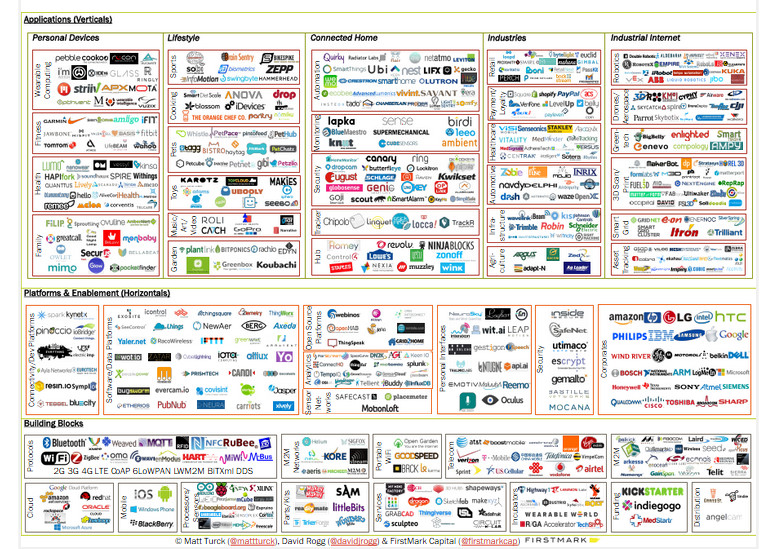  There really, truly is nothing new since the first wheel. Why then does the media expect Apple literally to invent a new wheel annually?
When the techno-journalists and analysts complain especially the native Internet media rags, that Apple is not launching any new products, what exactly did they expect? A driver-less skateboard? Pundits started that redundant litany again this week in anticipation of Apple's Fall product launch of some pretty amazing changes to the iPhone 6, Apple Watch, Apple TV and the new industrial strength iPad. From what I can tell these writers are young (by my standards) with little objective comprehension or perspective of the evolution of consumer technology...let alone the notion of product iterations. Iteration? What's that? Apple has always taken existing products and transformed them. Apple has not invented anything new from the earliest days (the blow back on that one should be interesting). They do transformative iterations. Amazing transformative iterations. Macintosh For example, desktop computing wasn't new, but making stand-alone computers that were not connected to a mainframe was a new iteration. IBM created a desktop computer and asked Microsoft to do the DOS Operating system. What a dog that was. Apple's iteration transformed the desktop computer. Giving a desktop computer a graphical user interface (GUI) and a mouse created the people-friendly brilliance of the Macintosh. Macbook Air At Apple, we joked about the weight of their first "portable" computer (the name for laptops in those days). It was so heavy, nine pounds, that we called it the "luggable". Just look at the Macbook Air now! That is a transformative iteration. iPod I bought a Sony Walkman, a personal portable music player, sold before today's new media writers were born. It was the coolest gizmo of its day, but loading music on it was always problematic and it wasn't petite. Apple made a smaller, cooler, touchscreen iPod with an iTunes music service to go with it.. That iteration transformed not just the product but the entire music industry. iPhone I had a Motorola mobile phone in the 1990's. It was the size of a brick. Then I got a Blackberry and read email. Apple made a transformative iteration called the iPhone that had a touch screen with apps, a camera, and music. Who knew a phone could do all that? Who knew it would become literally a hand-held computer and phone calls an anachronism? iPad Palm came out with a little tablet years ago called the Palm Pilot. It used a stylus to write on the screen. It was small, awkward, and only recognized a jargon alphabet that no one could remember. Apple's iteration, the iPad transformed the tablet into the product that for many replaced their laptops. Apple Watch The Apple watch is an iteration of digital wearable devices already out there that measure fitness and tell time. However, the Apple Watch is a product created with style, panache and sex appeal. It is their transformative iteration of the wearable device that will be commonly adopted. Are we so thought-controlled by the media that if they say it, then it must be true? The media and analyst disparagement of Apple is a shame and disservice to a company that generates remarkable product iterations . Not to mention lazy authorship. As I said, perspective: use it or lose it....or at least do the research. (Disclosure: I own a Samsung Galaxy phone, a couple Android tablets, and a PC with Windows 10. I did work for Apple a long time ago). Linkedin's blog just published the article below and infographic touting why you should publish on Linkedin. Here is why you should not limit your content sharing to Linkedin and why having your own blog/website is an idea whose time is way overdue. In fact, Linkedin is not the "best" place to publish, it is one of many good choices and some are better. Here's why:
Why Linkedin is the Best Place to Publish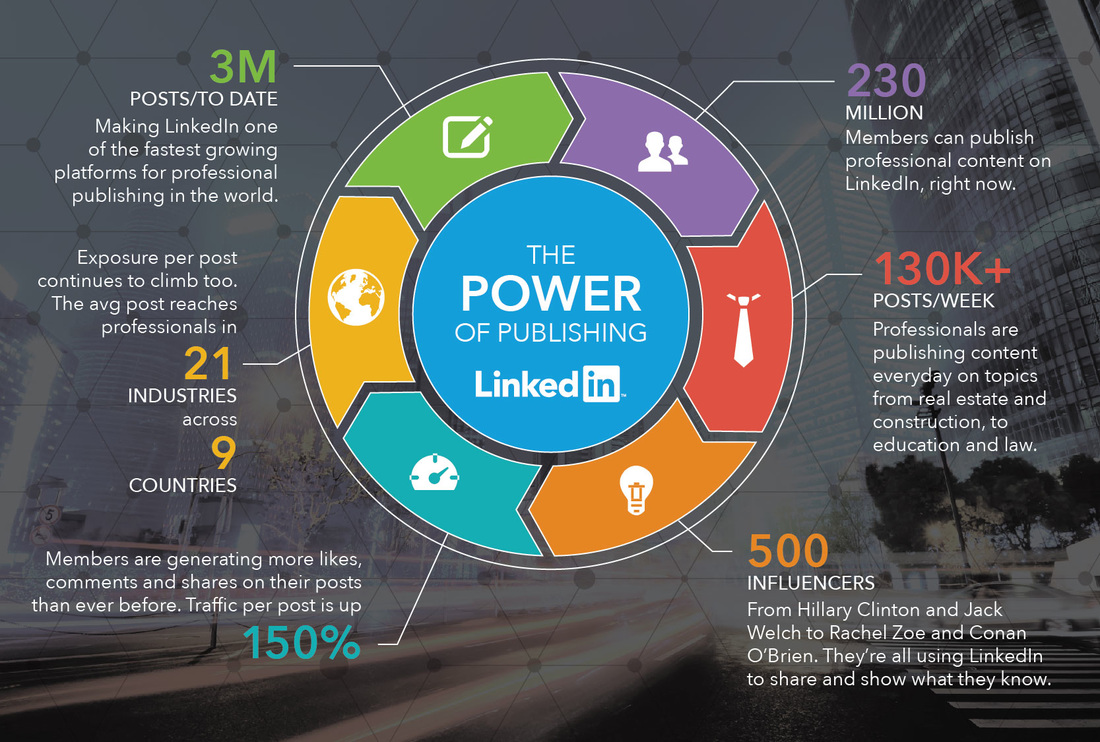 You have s,omething to say, but finding the right platform for your content is as important as what you have to say. If you’re a professional with a valuable perspective to share, you have to find the audience it will resonate with – the audience you can invite along for the ride. It’s that perspective that makes you unique – and that ability to spark conversation among your peers that can take you far. Just as you bring it to the table each day to work for your company, your platform can and should be working for you.
We know there are plenty of places to share your thoughts on everything from top food destinations around the world to top tips for getting the best manicure– but for content for that is relevant to professionals, LinkedIn is the only platform where the audience you want to reach is waiting for you, and wants professional content. Other sites have content in search of an audience but LinkedIn has an audience in search of content (in fact, more than 360 million professionals worldwide), and with it, you have the ability to speak directly to the people you want to reach. What does that mean for you? It means that publishing on LinkedIn can have a direct impact on you as a professional, like those experienced by Janet Matta, who landed her dream job in a new country thanks to a series of events that started with a post on salary negotiation , or Robbie Abed, who met his professional idol and mentor following a wildly crazy post he did on LinkedIn about how he took 250 coffee meetings in 400 days. You have the opportunity to reach other professionals from around the world – senior leaders, potential clients, employers, partners, mentors and more – the people that can impact your bottom line or have an impact on your career. The audience is here, and they are looking for the content, the thought leaders, the tips to help them grow in their careers — you as the writer, can be that expert. In fact, on average, posts on LinkedIn see 6x the views from people outside of your immediate network. That can translate to huge opportunity. Here’s how: But it doesn’t stop there–you can also see what impact you’re having. Once you’ve published on LinkedIn, check out your post analytics to see who read, shared, or commented on your post, plus important insights on the industries and regions your readers come from, their level of seniority, and how they found you. Leverage those insights to help tailor your message, share it with your network, and let the power of LinkedIn and your network get your content in front of the people that actually matter to you most. Share your perspective, build your professional brand, and let your voice be heard – most importantly, make sure it’s being heard by the professionals that matter to you. Find the blog here  Sometimes it seems nigh impossible to move the dial on an established, but obsolete, traditions like applying to a job posting and spreading your resume all over the Internet to find a job. The article below confirms this with statistics. It doesn't matter that more management and executive level professionals get hired through their networks than through job postings annually. That executive search consultants account for less than 10% of the executive positions placed annually in the USA. It doesn't matter that even before anyone sees your resume, they will see your social profile first. And, even if they get your resume first, they will look you up on Linkedin and search you out on Google to get tmore depth about you. And when they find something they don't like online, more than 50% of the recruiters surveyed say they drop you from their candidate list. People persist in using their resumes to apply to job postings. Why? Because it has always been done that way and because when it comes down to the actual interview, HR wants some kind of document to provide to hiring managers for reference. When will the transition to social profiles and personal websites take hold? If Linkedin has anything to say about it, it will be sooner not later. LinkedIn survey details 'new norms at work' Matt Kapko May 8, 2015 A new survey of 15,000 LinkedIn users with fulltime jobs, 1,000 of which reside in the United States, draws some interesting conclusions while also reinforcing common perceptions about the "new norms" within the modern U.S. workplace. More than a quarter (26.6 percent) of the people from the United States who were surveyed said it's important to maintain separate social media profiles for work and personal. One in five U.S. respondents (20.5 percent) said they make initial impressions based on a person's online profile picture. And one in 10 respondents said they worry about what their colleagues may think of them based on content they shared on social networks that may not seem professional, according to the survey, which was conducted by Censuswide for LinkedIn during the first week of April. Catherine Fisher, LinkedIn's career expert, says the findings stress the fact that people need to be mindful of how they portray themselves on social media. The U.S. responses also highlight notable difference between women and men in the workforce. Almost a third (30.9 percent) of women respondents said they are friends with colleagues on non-professional social networks, while only 16 percent of men said the same. Nearly a third of the women (32.5 percent) feel as though they're judged by what they wear to work, and more than a quarter (26.8 percent) said they believe men have it easier when it comes to the threads they don at work. And more than four in 10 women (41.6 percent) said they tend to dress up more when they have meetings during the day, while only 25.5 percent of the men step up their dress for meetings. Work experience, education and volunteer history are the three top factors U.S. users weigh to gauge a colleague's LinkedIn profile, according to the survey. More than one in five (21 percent) of those surveyed from the Unites States said it's more appropriate to self-promote now on social media than in years past. Almost 13 percent said they feel more comfortable sharing their opinions on industry matters via social networks, and nearly 9 percent think doing so is a great way to raise their professional profiles. Perhaps most surprising of all is that only 12.8 percent of U.S. respondents think a good LinkedIn profile is just as important as a good resume.  Last year, Linkedin opened up postings to the general membership. Prior to that time only Influencers (famous people, leaders in their field) designated by Linkedin were allowed to write those short, pithy articles that accumulated and archived on their profile pages. The rest of us had been relegated to ephemeral Linkedin Updates that disappeared into the news thread once posted.
In July of 2014, the little pen icon appeared on the update box, and intrepid trail blazers began posting on their Linkedin Profiles. What is a post exactly? On Linkedin, a posting is short article, essay, or observation on a topic of your choice with an accompanying image. The posting image along with an attention-getting title are important because your posts will be displayed on your profile by image and title as well as sent to all your first degree connections. Further, if you have written an interesting post that attracts Linkedin’s attention, they may choose it for redistribution to millions of Pulse subscribers, the site’s in-house news magazine. What you have to say might just be the differentiator for success depending upon your career goals and employment circumstances. Aside from writing posts because they attract attention to your profile and raise your visibility on the site, there are three compelling career motivators to do it as well. 1. Thought Leadership Build and demonstrate your knowledge and expertise in your current business sector and professional field. Anything you do outside your company will reflect back positively inside your company. Writing on your observations, insights, and unique perspective improves your stature in your field. Your post’s topics can open doors to consulting opportunities, creates visibility for potential board positions, and generates invitations to speak at conferences. You can position yourself as the go-to expert for media interviews. This all becomes a virtuous circle that continues to build on your reputation within your field or business sector. 2. Career Transition Making a career transition to a new industry more often than not requires some background in the new sector. That experience is the unspoken key criteria in a recruiter’s search that could be the deal breaker when it comes down to the choice between you and another candidate for a position. Hands-on experience is not always easy to come by up front, but postings helps build the bridge to the new industry or sector. Write about where you want to be not where you are. Write about the companies that you have targeted for employment. Yes, it takes some research and digging, but then you will be better prepared for interviewing. You will have demonstrated your knowledge up front, and established your credibility in advance by easily accessible postings on your Linkedin profile. 3. Gaps in Experience Writing on topics that are gaps in your knowledge or experience can move you past objections for a promotion and enable a career move. Rejection for employment and promotion typically lies in a skills or experience gap that doesn’t enable a complete “fit”. The bigger the company the less likely they are to overlook that. For example, you may have a solid background in retail marketing for bricks and mortar entities but no experience in e-commerce. Or, you have been a CIO for a very traditional company who had no need to use big data, data analytics, and social media in their business. Whatever the gap, the missing hands-on experience can be supplemented by writing posts about various aspects of it. Rather than trying to sell your value proposition past that gap objection during an interview, write about it in advance to leverage your credibility. Since 2008, Linkedin has gained critical mass with now over 1/3 of a billion members. It is the 800 pound gorilla in the job search room. What it decides to do in terms of their profile presentation, content and style drives the modern-day professional’s career marketing and branding initiatives. This is not to be trifled with as hiring decisions are rarely made now without at least a glance or even longer review of your profile. Worrying about privacy and jeopardizing your current employment status should be a non-issue now. The loss of momentum in your personal marketing out- weights your employer’s critical judgement. Once you have a robust profile in place, as your career progresses it is easy to use it to enhance and facilitate your success.  At a certain career stage, rising young professionals want to know how to be appointed to a board of directors. Unlike a job hunt where you should be the active party seeking a position, a board seat is supposed to come to you. There are, however, some things you can do to help the process along to gain a seat at the table.
Keep in mind that you have to be at the right level for the size, scope and type of enterprise seeking a board member. A small business owner might be invited to a local non-profit board in their town simply by starting to volunteer. But, a corporate executive would more likely be on a regional or national non-profit board through business colleagues. Board positions of privately held or public companies are a greater level of difficulty to achieve as your network needs to include those decision-makers and stake Here are some tips to get you onboard:
It is tough getting on boards. The small startup companies want people with either access to venture capital and private equity money or star power in the field. The mid-sized and big public companies want experts and top executives to guide and support their company’s top executives. Private company boards, especially small ones, tend to be an inside job, in that the board members are family, friends, and members of their support system. The best strategy is ongoing networking in the right place with the right people, so that eventually it is the right time for you to be asked.  Selling a service is like selling heroin...you need to get your customers rapturously hooked. Linkedin is the consummate example of this. When you think of your job search and how you present yourself, are you offering engagement with a set of services or are you presenting you, the product?
Seems to me that the more valuable course would be to present services to a company that they can partake of through a free advisor role, short term immediate consulting, or a longer term engagement. Thinking not about you the candidate to be hired as a product frees you to creatively present scenarios where engagement is win win for both you and the company. The Product-Service Shift – Transforming Your Operating Model by Geoffrey Moore (via Linkedin Pulse) As digital devices, cloud computing, and smart phone apps permeate more and more of our interactions, the product-service shift is overtaking more and more of our economy. This is a good thing from the point of view of lowering barriers to adoption and delivery costs, but it is a real challenge for vendors to transform their operating models to leverage the new infrastructure. A big part of the problem is simply getting our heads around the new paradigm. So much of the language of business is stuck in the old vocabulary, and that is causing us to make wrong choices without even knowing it. Let me show you what I mean. Take the combined notions of product marketing and product management. In a product company, although we often argue whose job it is to do what, we know overall what scope of work is involved. You have to spec out a set of features customers want, work with engineering to get them built into the product, work with marketing to get the product promoted, work with sales to get it sold, and work with customer support to get it serviced (and to collect a set of enhancement request for the next spec). But that is not at all how a service business works. Service customers don’t want features, they want outcomes. They don’t trust marketing that is outside the service experience; they expect to learn, try, and buy from inside the service delivery envelope. They don’t expect to be sold to, nor do they expect to use customer support unless somehow the service fails to deliver, which is more likely simply to cause them to churn out. So product marketing and management now equates to creating a completely contained environment within which both the prospective customer and the service vendor can experiment with each other across a digital interface to see if they have something of value to exchange. In this model there are no product releases. That is an obsolete notion that radically disrupts the low-latency give and take of a digital service engagement. Instead, the rhythm of that engagement is set by the spinning of four gears—Engage, Acquire, Enlist, and Monetize—all of which happen inside the service envelope. That means that engineering has to design and build the marketing directly into the service infrastructure, including whatever branding is needed. And the whole thing has to be built to evolve as A/B testing teaches us all what’s to, or not to, like. And that brings us to the freemium business model, in which there are no free trials because that concept implies that, if you like the trial, you will buy the product. That is not how a service model works. If you like the product, you will continue to engage with it, for free! Only after you have engaged deeply enough to be interested in a greater level of service can monetization be introduced. Here again the product mentality creates the wrong mindset. Product thinking says withhold the really valuable features, or give people a thirty day window, or do some other semi-coercive tactic to give you leverage in a purchase negotiation. These are dumb moves in the world of digital services, where losing the lifeline of user engagement costs you much more than continuing to support free. You have to learn how to woo rather than to bargain. And when it comes to purchasing, we think we want consumers to sign a license agreement, but that is a product concept designed to put power into the hands of the product vendor. What we want service customers to do instead is activate an account, something that keeps the power in their hands while creating a medium by which they can indeed spend money with us. The verb here is activate, not install, and our customer servicer outreach has to be structured accordingly. Similarly, when it comes to training, there can be no training. That is a product concept. Instead we need to orchestrate an onboarding process, one in which the user is guided through an experience instead of explained the intricacies of an interface. That’s why the hot new job title is called user experience design, no longer user interface design. And so it goes. All language is metaphorical to some degree. It is amazing how little it takes to put you in jail. Everywhere you turn it seems the legacy of a product-anchored vocabulary is insinuating itself into our thinking, leading us to make choices which are at best irrelevant and at worse self-defeating. So let me encourage you to engage your team in a language acid bath experiment, the goal of which is to root out as many product-centric phrases as you can and subject each one to a ruthless analysis of its implications, and then find a substitute phrase that will get everyone onto the right track. I think you will be shocked by what you find. Either way, I hope you report back. That’s what I think. What do you think? _________________________________________________________________________ Geoffrey Moore | Crossing the Chasm | Geoffrey Moore Twitter | Geoffrey Moore YouTube
C Is For Silly: The New C-Suite Titles
by Genna Goudreau Excerpt: ...Peter Cappelli, management professor at the University of Pennsylvania, says the new titles are meant to signal—internally, to customers or to governments—that a particular function or task is important and that the people at the top are listening. They may also be a form of ego appeasing and identifying who the important senior people are. “The main question,” he says, “is whether there’s any real substance behind them.”... Read full article here. Scott Brinker's marketing technology blog is a wealth of information and data on all the tools related to marketing and sheds light on the newest C-level job creation, the Chief Marketing Technology Officer. Read the blog and find out more. Maybe your next career move would be in this direction. 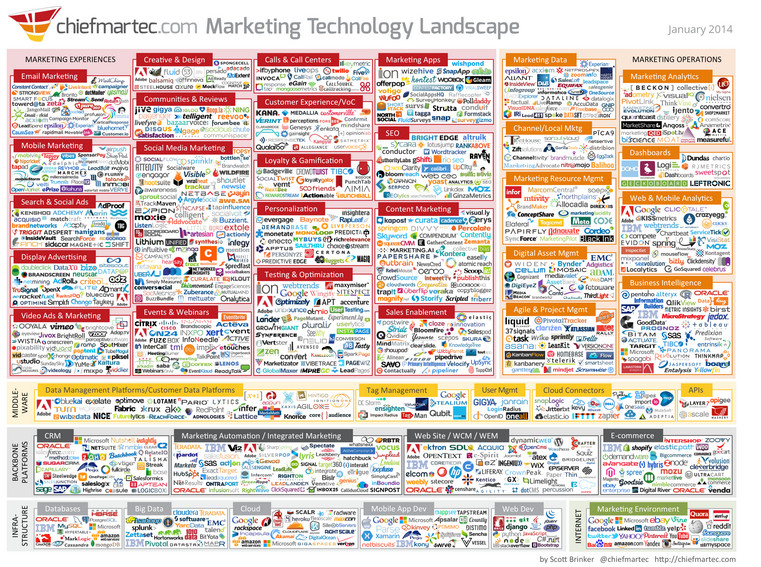 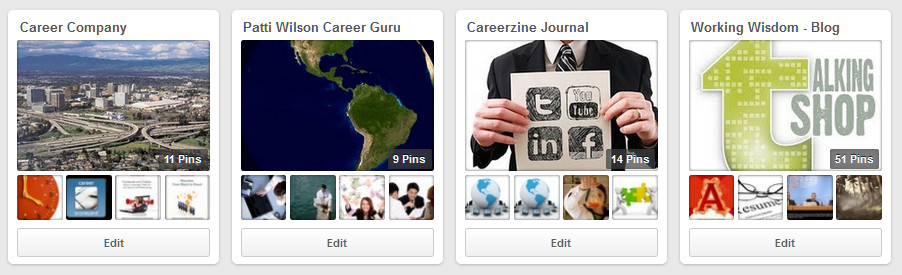 The Pinterest boards for my websites and blogs Image-driven content online is not just for selling and promoting products and retail entities. Professional services and, by extension, professional profiles online can and do benefit from images. Images are enhancers we can no longer afford to ignore as we create digital content and promote ourselves online.
Look at the trend on Linkedin to images in profile backgrounds, post images, group logos, and slide decks. Your Linkedin Groups page now shows each group's logo as images going down the screen similar in look to Pinterest's boards . Image-driven content, unless you are a products company or retailer, is a waste of digital space, bandwidth and scrolling time. However, great images succeed and are equaled only Buzzfeed's catchy titles in attracting viewer attention. Content may be king but images rule. Taking every opportunity to use image-driven content is crucial for professional promotion, online branding and visibility. Pinterest represents the opportunity for professionals to extend brand visibility and promotion using their boards to post images of blog posts, website pages, and self-images. When the Wall Street Journal first started posting their articles on Pinterest, every article they posted from their paper featured their boring grey logo. It was a sea of gray going down the screen with no differentiation of the articles except by title. Their titles were not Buzzfeed quality. In less than two weeks, they quickly read (or saw) the tea leaves and started using amazing images and photos to engage viewers and drive traffic from their Pinterest board posts to their website. Of course the obvious, practical profitable application of Pinterest boards is by Etsy members to attract attention to their products and drive customers to their Estsy store page for purchases. However, we professionasl can expand our digital footprint by setting up Pinterest boards for our website, blog and Linkedin posts, and other social-content sites. Each new page or post is then "pinned" to its respective Pinterest board by the image. The images above are from my Pinterest boards for my websites and blogs. Pinterest's image-driven content boards are a free online billboard that drives traffic to a website or blog or social profile for any professional. In addition, a presence on Pinterest can improve your Google name search ranking. And, of course, we all want to be found online.  This article in the ERE newsletter, written for HR and recruitment is even more true today. With the job market heating up, and recruitment focusing on digital profiles and information, a resume for most, but the highest executives, just gets in the way.
Why “Name-only” Employee Referrals Produce Dramatic Results by Dr. John Sullivan Oct 29, 2012, 5:42 am ET Employee referrals provide the highest quality and the highest volume of hires, but you won’t receive as high a level of results if you don’t minimize roadblocks to referrals. Requiring a current resume for employee referrals is a major “under-the-radar” detriment to reaching the goal of having referrals exceed 50% of all hires. Requiring a resume to start a referral process might not seem like a big deal (because the resume is “the currency” of recruiting) but it can be. Although “active candidates” all have current resumes, employed people who are not actively looking (some people call them passives) don’t have an updated resume available and they may have little interest in creating one. Requiring an updated resume in order to move forward slows down and occasionally stops employee referral efforts. Consider an alternative approach, which is offering an option to employees, so that all they must submit is a prospect’s name and contact information in order to begin the referral process. This approach is known as a “name-only” referral. read full article here
Do Won Chang (Hangul: 장도원) is an American businessman of Korean descent. He is best known for founding the clothing retail store Forever 21.
Chang grew up in South Korea and moved to California at 18 in 1981. He and his wife, Jin Sook (Hangul: 진숙), opened a clothing store then named Fashion 21 in 1984 in Highland Park, Los Angeles. His store took off and as he expanded to other locations, the store's name was changed to its current title Forever 21. The number of stores grew to 457 by 2010.[1] The company has since remained a family operation. Forbes in 2011 estimated Chang and his wife's net worth to be $2.2 billion.  What the article does not emphasie is that we the participants deliver the media with comments. What Facebook Will Look Like by 2024 by Todd Wasserman, Mashable.com Online empires come and go. At one time, Alta Vista was the top search engine and Netscape was the only web browser. Both are now gone. Will the same happen to Facebook? It's unlikely the company could completely exit the stage. However, the Facebook of 2024 will look very different from today's version. Primarily, the company will continue to morph from a social network to a more traditional media company. read full article here Start thinking about how you can transform your boring white papers into image-driven 200+ slide decks. Not many people are priinting out documents to read today when it is far quicker and easier to graze the information on your tablet or smart phone. Hence, the movement towards succinct delivery of information with images. Start rethinking your next boring 3 bullet powerpoint slide presentation. Re work it into a smal visual ebook instead. Or would you rather read formatted as an article? Note each sentence is a slide so instead of a short article you get to zip through a fun and interesting 70 slide deck. Launching a Career Comback, Linkedin Blog Post
How to Rock the Perfect LinkedIn Profile from LinkedIn Matt Henshaw June 11, 2014 Hello, I’m Matt Henshaw and (like the beautiful Slideshare above shows) I launched a successful career comeback. What does that actually mean? Well, a little while ago, I realised I was doing a job that was not my dream. So I decided to make a change and follow my dream – to become a singer-songwriter and self-sufficient working musician, like I said, my very own career comeback. Here’s my story and how LinkedIn played a part in it. From my time at school to the end of 2008, I was in a band called Censored. What started as a few lads from Nottingham messing about soon became serious. It was a great time – we were even supporting our music heroes, bands like Supergrass and Ocean Colour Scene. And hanging out with the likes of the Kaiser Chiefs and the Arctic Monkeys – what could possibly go wrong? I suppose I never really thought about the future and without any real guidance, we took on too much and spread ourselves too thin. I got burnt out and had to cancel gigs and festivals. Sometimes when you lose momentum, you don’t find it again. I was in touching distance of my dream career – then it was suddenly over. Skip to 2012, I was working as a Computer Science Sustainability Research Assistant – try saying that with your mouth full! It was OK, it paid the bills but it wasn’t my dream. Then I went to watch some music gigs for the first time in a long time. The Stone Roses had reformed and Jack White was playing solo shows with all the joy and freedom that goes with it. And that’s when it hit me – I’m one of these people, I’m a musician, that’s MY dream! I had to get back in. But the music landscape had changed since 2008. And it hadn’t exactly gone well last time. That’s where LinkedIn came in. I thought if this can work for office stuff why not music as well? I wanted to showcase my passion, my personality and make sure people took me seriously as a professional – not just another lad with a guitar. After updating my profile, I soon found endorsements rolling in from my old network backing my music skills. It was a massive confidence boost. Then I found people started coming to me! For gigs, festivals and just putting stuff together in the recording studio. My profile was like a magnet – all because I had added a bit more detail. I now have a gig at the Camden Roundhouse and the Elevator Music Festival. You may be thinking “good for him but I don’t want to be a musician”. Well, that’s not my point. Whether you’re a musician, a lawyer, a scientist or an accountant you can always do better. LinkedIn is for anyone with ambition. It’s not going to magically make things happen for you, but if you want to follow your dream then investing in your profile and having LinkedIn in your corner can only help. LinkedIn played its part for me and it can for you. What’s your dream? Peace, Love & Tea, MHx PS. If you like my Slideshare, why not share it on The article goes into the details if you are interested. I would think this confirms what everybody knows already. 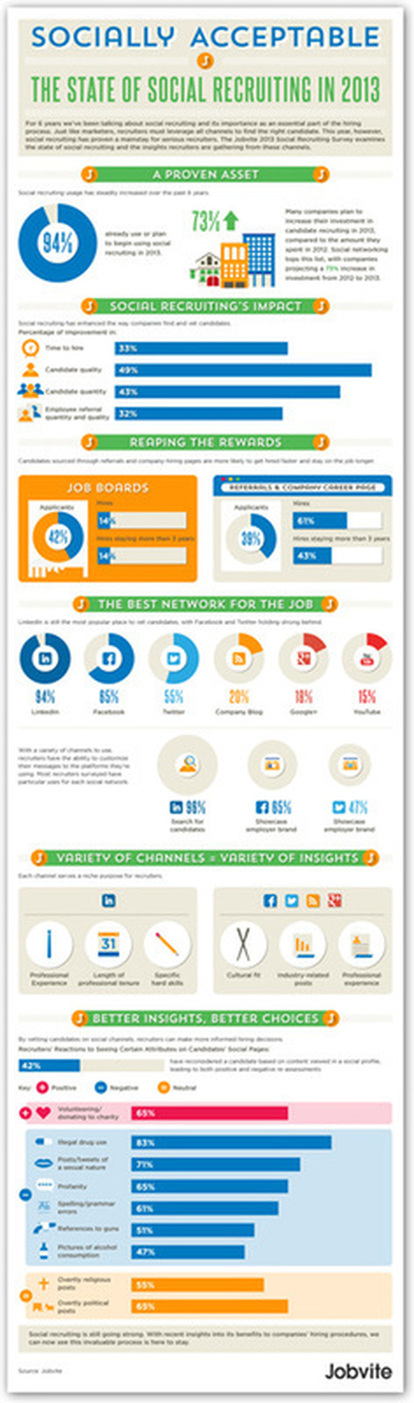  It will be interesting to watch Zillow's entry into China with the US housing market site translated into Chinese. There is the expectation of a flood of wealthy investors from China rushing into all US markets. This seems to be a spread across the globe of wealth control by the few.
When the country was first founded only property owners could vote and everyone else was disenfranchised. Are we moving to a new kind of public disenfranchisement? With years of student debt upon graduation, diminished opportunity to own a home which represents financial stability, and no job security, are we passing on a future devoid of opportunity for the next generations? Families Blocked by Investors From Buying U.S. Homes By Kathleen M. Howley - Oct 24, 2013 7:10 AM PT The homeownership rate declined to 65 percent in the first half of this year from a peak of 69.2 percent in June 2004. The level is expected to stabilize at about 63 percent, adding more than 2 million households to the rental population, according to Morgan Stanley analyst Haendel St. Juste. Pendulum Swings Families are still able to live in single-family homes with a yard for their kids to play in, said Daren Blomquist, a RealtyTrac vice president. However, they’re sending their money to investor-landlords, rather than paying off a mortgage. “The pendulum is swinging too far from the direction we saw during the run-up to the mortgage crisis,” Blomquist said in an interview. “Then, we tried to make everyone an owner. Now, we have people who have the income to pay a mortgage and have the desire to own a home who are stuck being renters.” Read the article and view the video here Rarely do I promote an event especially to global readers. But, this one is cool and will be recorded to watch later from wherever. The news is that companies are going to hire you now based on comprehensive set of data points gathered about you online that are nowhere to be found on your resume. Forget transferable skills, folks. This is far more comprehensive, intrusive and penetrating into your personality/style, mannerisms, predictable behaviors, competencies/abilities, and unstated accomplishments. None of these are even touched on your resume but they are online. What if they knew the articles and quotes you shared on social sites? What if they could scrutinize the people you interact with all over the Internet? What impact would that have on how you present yourself for employment opportunities.. The solution? Manage your message and your privacy settings. They will be searching for the most recent information on you.My guess is less than a year and two years max. Start now and build a brand/marketing image/ reputation online that delivers the message you want them read.  Algorithm Alchemy: Turning Talent Search into Gold Thursday, June 19, 2014 LOCATION: Stanford Graduate School of Business Knight Management Ctr - Cemex Auditorium, Zambrano Hall 641 Knight Way, Stanford, CA (Parking and Directions) 6:00 pm – Registration, Networking Reception & Demos 7:00 pm – Panel Discussion (Q&A) Startups are turning the tables on recruiting with targeted prospecting algorithms. Applicant search is transformed intoprecise talent-matching through the collection and curation of data from numerous sources. The new platforms level the playing field, reshaping the interaction between job seekers, recruiters, and hiring managers. There is a new gold rush in the global talent acquisition market! According to Bersin by Deloitte, the global talent acquisition market is now worth over $150B annually. While online job boards and aggregators continue to hold the largest slice of the pie, new entrants are poised to take away significant market share. Join us on Thursday, June 19th to find out how today’s alchemists are exploring new frontiers in the job market, disrupting an industry that has become inefficient and unwieldy:
Alex Dévé, Founder and CEO, Whitetruffle Sheeroy Desai, Co-founder and CEO, Gild Steve Krausz, General Partner, U.S. Venture Partners Demo Companies: Readyforce | Venturocket | Whitetruffle ** More panelists and demo companies to be announced soon. Please continue to check back. ** Follow (@VLAB) on Twitter and Event Hashtag #VLABtalent It must be big news as last year had 117 slides and now she is up to 164. Good promotion for Linkedin who bought Slideshare where this is posted. Reid Hoffman has called these highly robust, rich, detailed slideshows "visual executive summaries". I like to call them, "finally, a readable and interesting white paper"
 After reading the article below, I could only agree. Of course companies want to hire great people, and they do have a key set of attributes that they look for.
But how do they really go about finding these A Players? They sure don't ask you in an interview, "Are you a self-disciplined, champion with foresight, and a drive to compete, who operates at high integrity?" The A-player college screen starts before the interview, way before, as in what is your GPA, SAT score, leadership participation on campus, and the pedigree of your degree and college? The last one is the biggie. And, how much work experience do you have in your chosen field, as in years not days or months. Seriously, the degree alone won't do it. That's for new grads. If you are a seasoned professional as an A-player, you will need to be employed (not self-employed or unemployed), in an identical position and equivalent level to the company's opening. You will be working already in the company's business domain or industrial sector. Finally, do not be looking for a job, as they do want to find you. How to they screen for the characteristics below? Well if they are smart hiring companies they will do 3 things to all hires: new grads to experienced executives.
Forbes Magazine: The Five Characteristics Of An 'A' Player For many startups, hiring the best and the brightest is not an option — it’s an absolute necessity. You’ve probably heard this sage, albeit generic advice before: “Only hire ‘A’ players.” Of course! Who doesn’t want “A” players? Who doesn’t want people who have the talent, skills and drive to make a company successful? But the real question is: Can you recognize a top performer when you meet him? We all like to think we can, but even the best can overlook real talent. Think back to Facebook and Twitter. Both companies failed to hire Brian Acton, cofounder of WhatsApp, which was recently acquired by Facebook for $19 billion. Mark Zuckerberg, founder and CEO, shows off the new messaging system in Facebook. (Photo credit: Wikipedia) Simply put, “A” players are great competitors. Avoid overlooking one in your midst by understanding these five characteristics:
What characteristics have you found in your best hires? Mary Ray is the co-founder of MyHealthTeams, which just closed a Series A round. She is always on the lookout for A-players. She drives the product vision and product development of all the MyHealthTeams’ web and mobile applications, oversees marketing, UX, design. The Young Entrepreneur Council (YEC) is an invite-only organization comprised of the world’s most promising young entrepreneurs. In partnership with Citi, YEC recently launched StartupCollective, a free virtual mentorship program that helps millions of entrepreneurs start and grow businesses. Read article here  New branding on a theory with a proven track record. Daniel Goleman wrote about EQ (Emotional IQ) several years ago making the point that people need not just smarts to get ahead as in IQ but the ability to relate to others as well. In fact the EQ was more important than the IQ all things being equal.
It is now as a theory moving into action and coming to real fruition with social networking and social media inside and outside organizations. Also globalization impels communications by video. The article is filled with good advice, and overview of the current situation. This continues to build a case for a good digital footprint that includes video, audio, image and content. Your first impression precedes you online and then in reality you will need to live up to it. ~~~~~~~~~~~~~~~~~~~~~~~ Why Likability Matters More at Work Likability Is More Important—and Harder to Pull Off March 25, 2014 7:03 p.m. ET, Wall Street Journal Is "Likability" is becoming a bigger factor for success at work as social networks and videoconferencing grow. The impact goes beyond a high-school popularity contest. The ability to come across as likable is shaping how people are sized up and treated by bosses and co-workers. Likable people are more apt to be hired, get help at work, get useful information from others and have mistakes forgiven. A study of 133 managers last year by researchers at the University of Massachusetts found that if an auditor is likable and gives a well-organized argument, managers tend to comply with his suggestions, even if they disagree and the auditor lacks supporting evidence. Likability is more important—and harder to pull off—on video than in person. Sometimes this can result in a style-over-substance effect. People watching a speaker on a videoconference are more influenced by how much they like the speaker than by the quality of the speaker's arguments, according to a 2008 study in Management Science. The opposite is true when a speaker appears in person. The use of personal videoconferencing is expected to grow 47% annually through 2017, according to Wainhouse Research, a Boston market-research firm. Read full article here |